Comfortless Bodies

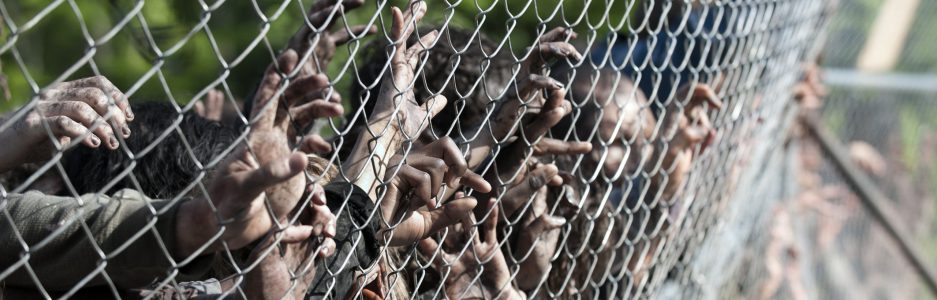
(4e) Recalling Daphne Marlatt’s joy in the “mutuality” between human and animal bodies who can give and share their creaturely warmth (though I’m sure she’s thinking of cats more than, say, octopi), we note that the Zombie can neither give nor receive comfort. Its embrace is repellant. (Here, we might suggest that the abject rather than the uncanny is the appropriate psychoanalytic category for the Zombie). On the flipside, the Zombie is likewise comfortless. The Walking Dead has recurrently featured characters whose attempts to console or nurture a ‘Walker’ garner pity or frustration from the other survivors (the Governor’s care for his zombified daughter, Hershel’s initial insistence that his family members are merely sick and need care); invariably, these endeavours are acknowledged to be fruitless, if not plainly dangerous. The Zombie stands in direct contrast to both the animal victim who calls out for human care and protection and the pet who offers up its body for comfort and companionship.

Because it is dead. I argued that the traditional view of ‘the animal’ has worked to suppress an awareness of the similarity between living things and the obligations that could arise from its acknowledgment. For this reason, it’s the Zombie’s deadness that makes it a such a useful animal substitute (it’s the tofu or, more accurately, the cultured meat of the fictive world). It is not even an animal because not sentient enough to feel pain, to experience freedom from pain as a kind of natural state of contentment.

There are many instances of cruelty to Zombies, or rather specific actions that are figured as cruel: the doctor’s experiments on ‘living’ Zombies in Wyrmwood, the chaining and taunting of an infected soldier in 28 Days Later. In The Rezort, an island is “stocked” with zombies who are hunted for sport, an activity viewed with contempt by the main protagonist and moral voice of the film. In these instances, the Zombie is clearly meant to register in our moral calculations as analogous to the animal who deserves better treatment. But the mainstream tendency seems to absolve the human subject of any accusation of cruelty no matter her treatment of the Zombie on the basis of its inability to feel pain. It is perfectly acceptable in The Walking Dead to use zombies as target practice, to weaponize them—even to chop off their arms, remove their lower jaws, and lead them around on chains as Michonne does. To the extent that the non-sentient Zombie provides no obvious basis upon which we could regard it as deserving of rights, the Zombie emerges as a third-term in the human-animal binary. (Or, to the extent that the animal is disappearing altogether, it is taking its place in the binary.) It is an animal unlike animals which, though they lack human speech, nevertheless share with us an aversion to suffering. From Bentham’s point of view, the Zombie makes no claim on us for consideration. In this sense, it is not like the animal we now know; but if one of the historical uses of the animal in narratives of conflict and crisis was to provide a surface against which to project human fortitude, loyalty, and ambition, then it’s a perfect substitute precisely because there is no sense that it deserves, or can ask for, its share in the world to come.

The Zombie is threatening because it wants to attack and eat us. But it is reassuring in its terror because it operates so far outside the human realm of reason and restraint that it places no obligations on us for accommodation.


Fellow Travellers: Daphne Marlatt, Jeremy Bentham

Stops: The Walking Dead, Wyrmwood, The Rezort

Savage Men and Beasts


(4d) The forest setting of a film like Here Alone (2016) in which a trio of survivors take great precautions to protect their camp from the infected marauders that roam the countryside contributes greatly to the homesteader vibe of the whole. It recalls a long tradition of colonial and settler literature in which the place of the Zombies would be occupied by wolves, bears, or Indians. Near the end of his The Deserted Village (1770), Oliver Goldsmith imagines the fate awaiting the villagers of Auburn who have emigrated to the Americas after being forced from their ancestral lands as a consequence of the enclosures:

To distant climes, a dreary scene,
Where half the convex world intrudes between,
Through torrid tracts with fainting steps they go,
Where wild Altama murmurs to their woe.
Far different there from all that charm’d before,
The various terrors of that horrid shore;
Those blazing suns that dart a downward ray,
And fiercely shed intolerable day;
Those matted woods where birds forget to sing,
But silent bats in drowsy clusters cling;
Those poisonous fields with rank luxuriance crowned,
Where the dark scorpion gathers death around;
Where at each step the stranger fears to wake
The rattling terrors of the vengeful snake;
Where crouching tigers wait their hapless prey,
And savage men, more murderous still than they;
While oft in whirls the mad tornado flies,
Mingling the ravaged landscape with the skies.

True, he’s a little unclear on the zoological facts of the New World. But the motif is so powerful that even his grand-nephew, Oliver Goldsmith (Junior), a local, reproduces it near verbatim 50 years later in his own poetic history of the settlement of the colony of Acadia:

Behold! the savage tribes, in wildest strain,
Approach with death and terror in their train;
No longer silence o’er the forest reigns,
No longer stillness now her pow’r retains;
But hideous yells announce the murd’rous band,
Whose bloody footsteps desolate the land;
[……………………………………………………………….]
He hears them doom the white man’s instant death,
Shrinks from the sentence, while he gasps for breath;
Then, rousing with one effort all his might,
Darts from his hut, and saves himself by flight.
Yet, what a refuge! Here a host of foes,
On ev’ry side, his trembling steps oppose.
Here savage beasts terrific round him howl,
As through the gloomy wood they nightly prowl. (“The Rising Village,” 1825)

The interchangeability between indigenous people and wild animals is abundantly clear: both are “murd’rous;” neither speak; the one “howls” while the other only “shrieks.” What strikes me about these passages is how, in the postmodern and postcolonial context, the structure of these narratives has remained intact but with Zombies taking the place of ‘savage’ men and beasts. I’m not in any way suggesting that the Zombies symbolize or stand in for either animals or indigenous peoples. What I am saying is that the Zombie does the same work as these earlier figures: a demonic force, it stands opposed the human values and desires embodied in the social project, namely those values of order, reason, restraint, civility, etc. What’s changed is that the animal and the savage can no longer perform this structural role. In a particularly over-the-top sequence in season 7 of The Walking Dead, Rick and Michonne bisect hundreds of Zombies with a steel cable strung between two speeding cars. It was epic—no, literally: in a different age, the Zombies would have been Trojans, or Indians, or lions. (Can you imagine an audience’s reaction to the same scene were the Zombies human or an animal we love, like elephants or baby seals (vicious baby seals)? The Zombie is an unloveable animal, an uncivilizable man.

The Zombie conforms to our earliest Western conceptions of the animal as not-human. It possesses neither language nor reason nor self-consciousness. It is incapable of feeling naked. (In the future, I’d like to think more about the Zombie’s clothing or lack thereof.) It cannot learn or progress, only spread. It cannot plan. It cannot practice restraint. It cannot form bonds. Because it lacks tools or know-how, the Zombie must kill with its body. That body is confronted by men and women with guns, axes, knives, crowbars, shovels, hammers, swords, and so on—as if to confirm that the human is to be found in the using of tools and the non-human in not. In Romero’s oeuvre, the Zombies use basic tools, but they also develop speech. The allusion to indigenous or native populations who lack both discursive and technological means to assert their rights is clear. By moving from presumed beast to an embattled protester, however, Romero’s Zombie exemplifies the same logic I am trying to demonstrate here: in those films and books where the Zombies do not use tools or speak, a wish for an animal that can never turn out to be more than an animal is being satisfied. Romero’s films bring that desire to the narrative surface in order to thematize it.

The Zombie is a dead, yet animate, homo sapiens. It is not really an animal, though it is repeatedly compared to and treated like one. Indeed, in our Zombie narratives we reserve for ourselves an (almost) unquestionable right over the Zombie’s body that is not so different than that which we exercise when we eat veal cutlets or ride a horse: we grant ourselves the right to kill it, use it as a tool or a weapon, to—as in the case of the movie Fido (2006)—even domesticate it because it is less than us, seemingly apart from us, and unable to voice a protest against its mistreatment in our own terms—the only terms we allow to count. I earlier suggested that becoming-Zombie was marked by a loss of language and speech; the moment when growls or groans issue from the subject’s mouth rather than recognizable discourse is the moment of his transposition into the realm of death and instinct. It is worth thinking about the Zombie’s mouth again. It is a mouth that can only bite; if to be human is to have a mouth that both eats and speaks, then the Zombie is something other than human. Its being is not divided between matter and spirit, body and mind, nature and culture: it is only matter, body, nature (though unnatural in origin, is actually pure nature.) We are no longer certain that animals lack language, but we are sure the Zombie does. And in those rare instances when it does surprise us with speech, it is as though a rat or a dog had just called up and asked to be invited to the party. (See Section 2a for a discussion of the speaking Zombie as rights-seeker.)

Fellow Travellers: Oliver Goldsmith, Oliver Goldsmith (Junior), George Romero

Stops: Here Alone, The Deserted Village, The Rising Village, Fido, The Walking Dead