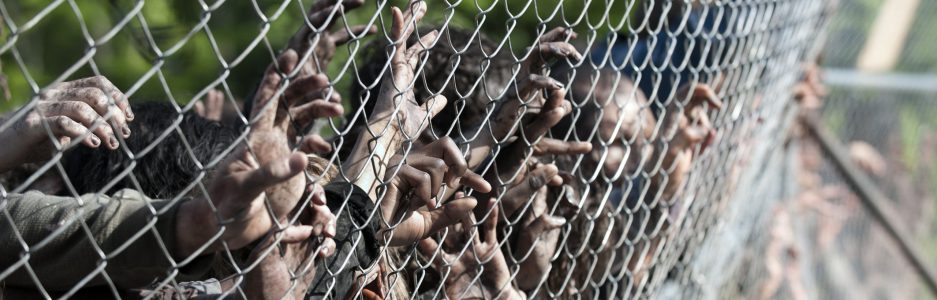
(4e) Recalling Daphne Marlatt’s joy in the “mutuality” between human and animal bodies who can give and share their creaturely warmth (though I’m sure she’s thinking of cats more than, say, octopi), we note that the Zombie can neither give nor receive comfort. Its embrace is repellant. (Here, we might suggest that the abject rather than the uncanny is the appropriate psychoanalytic category for the Zombie). On the flipside, the Zombie is likewise comfortless. The Walking Dead has recurrently featured characters whose attempts to console or nurture a ‘Walker’ garner pity or frustration from the other survivors (the Governor’s care for his zombified daughter, Hershel’s initial insistence that his family members are merely sick and need care); invariably, these endeavours are acknowledged to be fruitless, if not plainly dangerous. The Zombie stands in direct contrast to both the animal victim who calls out for human care and protection and the pet who offers up its body for comfort and companionship.
Because it is dead. I argued that the traditional view of ‘the animal’ has worked to suppress an awareness of the similarity between living things and the obligations that could arise from its acknowledgment. For this reason, it’s the Zombie’s deadness that makes it a such a useful animal substitute (it’s the tofu or, more accurately, the cultured meat of the fictive world). It is not even an animal because not sentient enough to feel pain, to experience freedom from pain as a kind of natural state of contentment.
There are many instances of cruelty to Zombies, or rather specific actions that are figured as cruel: the doctor’s experiments on ‘living’ Zombies in Wyrmwood, the chaining and taunting of an infected soldier in 28 Days Later. In The Rezort, an island is “stocked” with zombies who are hunted for sport, an activity viewed with contempt by the main protagonist and moral voice of the film. In these instances, the Zombie is clearly meant to register in our moral calculations as analogous to the animal who deserves better treatment. But the mainstream tendency seems to absolve the human subject of any accusation of cruelty no matter her treatment of the Zombie on the basis of its inability to feel pain. It is perfectly acceptable in The Walking Dead to use zombies as target practice, to weaponize them—even to chop off their arms, remove their lower jaws, and lead them around on chains as Michonne does. To the extent that the non-sentient Zombie provides no obvious basis upon which we could regard it as deserving of rights, the Zombie emerges as a third-term in the human-animal binary. (Or, to the extent that the animal is disappearing altogether, it is taking its place in the binary.) It is an animal unlike animals which, though they lack human speech, nevertheless share with us an aversion to suffering. From Bentham’s point of view, the Zombie makes no claim on us for consideration. In this sense, it is not like the animal we now know; but if one of the historical uses of the animal in narratives of conflict and crisis was to provide a surface against which to project human fortitude, loyalty, and ambition, then it’s a perfect substitute precisely because there is no sense that it deserves, or can ask for, its share in the world to come.
The Zombie is threatening because it wants to attack and eat us. But it is reassuring in its terror because it operates so far outside the human realm of reason and restraint that it places no obligations on us for accommodation.
Fellow Travellers: Daphne Marlatt, Jeremy Bentham
Stops: The Walking Dead, Wyrmwood, The Rezort
 Thoughts on Zombies