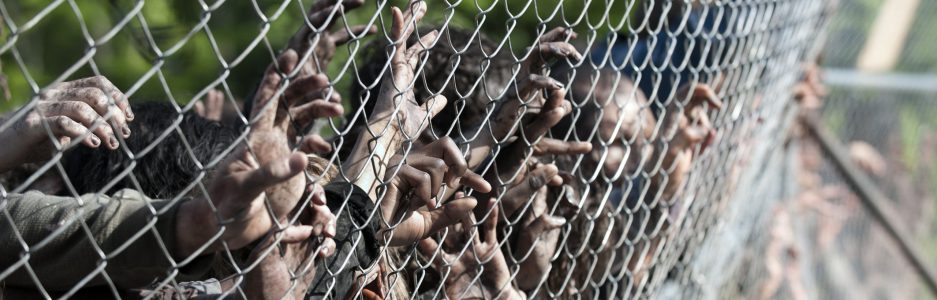
5a) What models exist today for representing the human body? How do we encounter, in our acts of visual consumption, the bodies of others? (Of others, but always also our own body, projected and re-encountered as friend or foe.) Today, in the West, we drift between two dominant models of corporeality: pornography and horror—with sport occupying an uncomfortable, though privileged, place between these opposed extremes. The mainstream pornographic subject is scrubbed, hairless, free or injury (or disease, or any other signs of morbidity), odourless (even through our screens, odourless—we are sure); its body is frictionless and contained: yes, the semen flows, but it does not stick, even though it looks like Elmer’s glue; the bodies writhe and climax, but without danger of excess; there are no bodily surprises, accidents, failures. Antiseptically clean, the pornographic body is purged of its own biological corporeality: mirrored sunglasses brought to life; moaning bottles of Febreze. At the other pole, the zombie, whose own moaning sounds are tellingly similar (Jolanda, last night, calling out from the bedroom ‘What are you watching out there?’ as I screened Night of the Living Dead for class.) Has not the zombie become more morbid, more physically corrupt, more disgusting in direct proportion to the sanitization that pornography has undergone? (And, indeed, that those machines in the mirror to which minister every day have likewise, in great measure, undergone?) All the bodily signs that have been jettisoned from that world reappear, exaggerated, in the world of the zombie. In particular, whereas the pornographic body is, as I suggest, frictionless (like Teflon, capped teeth, and the bowls of expensive toilets) the zombie body is really very sticky: it sticks to things and things stick to it. The Return of the Living Dead (1985) has some excellent sticky zombies (that stink: you can smell it through the screen). Even the zombies of The Walking Dead tend to bear the residue of their trips and travels. These bodies have histories. Another way of saying what I’ve been saying might be that the mainstream pornographic body has no history; it does not exhibit any residue of experience. If the zombie, as has been asserted repeatedly, is a figure of both repulsion and attraction, this tension may in part speak to our own conflicted relationship with our own corporeality. We have come to hate and fear our bodies which we attempt to purge of any signs of natural morbidity and mortality (hair = a reminder of death.) Yet we seek out the corrupt body of the zombie as much as we satisfy ourselves with its disinfected negative image. Something in us misses those bodies we left behind. But some balance, some organic tertium quid has been irrevocably lost, I suspect, that we can only artificially and imperfectly approximate by way of a schizophrenic vacillation between exaggerated contraries. Future research: the zombie pornographic film (eg. Erotic Nights of the Living Dead, Porn of the Dead, Grub Girl. ‘What are you watching out there?’)
 Thoughts on Zombies