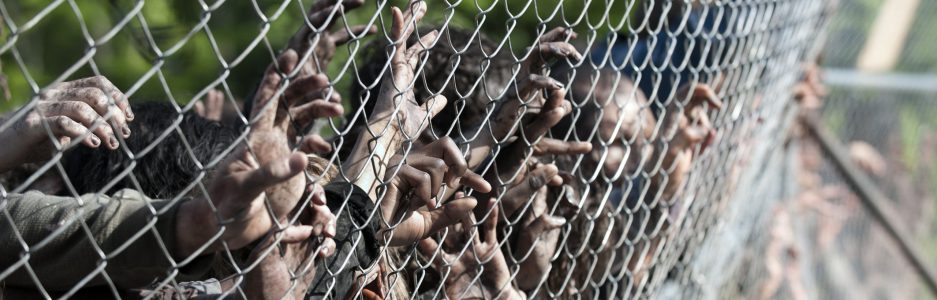
“Monsters have always defined the limits of community in Western imaginations” (64), writes Dona Haraway in “The Cyborg Manifesto” (1991). This is unquestionably true. I have so far been interested in tracing the political possibilities and (generally hidden) ideologies set in in motion by texts within the non-sentient (‘all dark inside’) zombie tradition typified by The Walking Dead. I have had less positive, and admittedly less insightful, things to say about that other tradition, the talking zombie—or what Kyle Bishop calls the “agentic zombie” in his compelling essay about teachers and teaching in Carey’s The Girl with All the Gifts. Here, because they have language, consciousness, and will, Zombies are“agents:” self-aware and self-directed beings. By figuring what we might call the ‘non-human person’, The Girl with All the Gifts challenges a humanist tradition in which personhood (and the ‘standing’ or privilege attached to it) is irrevocably tied to an unexamined (implicitly coherent, totalizing, centred) idea of ‘humankind.’
The Girl With All the Gifts is consequently engaged in what Haraway calls “category work” that poses the question of community within a broader questioning of humanity and the human. There is a way in which all zombie narratives promote a way of thinking that apprehends the human individual as the member of a species that takes its place (and takes up space) alongside and in relation to other species on a planet on which resources, including space for living itself, are finite. By the very antithetical nature of its plots, the zombie narrative constructs for ‘us’ a species identity that does not transcend so much as deconstruct other filiating categories such as nation, race and gender. At least potentially, the notion that ‘the fate of the entire human species is at stake’—explicitly uttered or implicitly felt in so many zombie stories—encourages a species view of human life, a view that we desperately need if we are to construct ecologically and politically viable (not to mention just) models for our continued planetary existence. Even so, it is also true that most non-sentient zombie narratives encourage this species view while simultaneously consolidating it around liberal humanist notions of ‘the person’, which usually entail clear-cut distinctions between self and other, human and animal, organic and inorganic, civilization (meaningful order) and wilderness (chaotic unmeaning), etc. Ironically, the very interstitiality of the figure of the ‘undead’ upon which these narratives are based generates narrative structures that are, generally speaking, highly intolerant of mixture, confusion, interpenetration, or métissage of any kind. An anxious object (or rather an object of [our] anxiety) the non-sentient Zombie motivates a thinking towards new forms of community and political organization but stops short of problematizing the ontological status or ‘nature’ of its subject-citizens by refusing to depart from already-established notions of humanity. Whatever new world it imagines emerging out of its apocalypse, it’s always a world by and for human persons.
This is, however, is less true when it comes to the talking or agentic Zombie which manifests what is sometimes called a dirty ontology. The Girl with All the Gifts, de-centres and relativizes the human person by introducing a third term to the typical binary structure of the zombie narrative, a second generation of zombie children who possess all the verbal and intellectual capacities denied their parents. In the book, zombies, on occasion, literally engage in ‘mindless’ sex (to go along with their mindless violence) thereby producing offspring who are clinically dead but are otherwise hyperbolically ‘human’ (hyperbolic because they are not only mentally and physically more capable than normal human beings, but possess an imaginative sympathy seemingly lost to a humankind pushed to the edge of extinction).
But the “gifts” in question are not so much these abilities but rather the stories—Greek myths and children’s classics—that the main character Melanie has been taught by her teacher Miss Justineau. Crucially, these stories persist, are carried into the future, as world-(re)building metanarratives but not by human beings, who by the end of the novel are extinct, but by a generation of quasi-zombies who are explicitly, emphatically, not human. The novel produces a paradoxical situation in which human history carries on past the end of humanity itself: its continuity depends on a radical discontinuity and substitution at the level of the historical subject; whatever history is—potential, growth, emergence, change-in-time —it isn’t for (or about) humans anymore. The provocative point of the novel is that humans have squandered their inheritance; they don’t deserve to survive, even if their stories do.
Having triggered a massive release of the fungal spores that turn humans into the undead “hungries,” thereby killing off the earth’s few remaining embattled (and battling) survivors, Melanie explains:
It’s terribly, terribly sad for the people who get it first, but their children will be okay and they’ll be the ones who live and grow up and have children of their own and make a new world. “But only if you let them grow up,” she finishes. “If you keep shooting them and cutting them into pieces and throwing them into pits, nobody will be left to make a new world. Your people and the junker people will keep killing each other, and you’ll both kill the hungries wherever you find them, and in the end the world will be empty. This way is better. Everybody turns into a hungry all at once, and that means they’ll all die, which is really sad. But then the children will grow up, and they won’t be the old kind of people but they won’t be hungries either. They’ll be different. Like me, and the rest of the kids in the class. “They’ll be the next people. The ones who make everything okay again” (399).
The theme of restoration here does give one pause, as it seems rather indebted to a myth of return or of ‘paradise regained’ which critics from Jean-Luc Nancy to Haraway have identified as one of the mythological projects through which human beings have asserted their sovereignty over and against every other living organism on the planet. But that’s part of the novel’s strange telos: the stories and frameworks carry on as the intellectual machinery of another species which has appropriated them for their own purposes. The “next people” are not human beings. They are fundamentally “different.”
But the Zombie kids aren’t really that different —or aren’t quite different enough. In “The Cyborg Manifesto,” Haraway mentions Katie King’s observation that when it comes to experimental feminist science fiction, readerly pleasure does not depend on one’s identification with the figures or characters that embody the texts’ category-confusions. But we all-too-easily identify with Melanie in The Girl With all The Gifts. Yes, she doesn’t need oxygen and blood doesn’t actually circulate in her veins, but for all intents and purposes she’s really just a very pale ‘human’ being. What had initially seemed to be an attempt to think through species, in the end turns out to be rather more generational than ontological in its displacements. The “next” people still seem an awful lot like people. (When I taught this book to my undergrads I started the class by playing Whitney Huston’s “The Greatest Love of All,” which too easily expresses the theme of the novel: “I believe the children are our future; teach them well and let them lead the way….”).
A zombie movie that comes closer, in my thinking, to producing the discomforts proper to a genuinely ‘dirty ontology’ is the Canadian film Fido (2006) directed by Andrew Currie. Starring Carrie Ann Moss, Dylan Baker, and Henry Czerny, the film features comedian Billy Connolly as the eponymous Fido, a zombie domestic servant assigned to an ersatz atomic age family called the Robinsons. Harkening back to pre-Romero comic book zombies, Fido is a greenish groaning klutz—more pathetic than scary—but take off his restraint collar and he will instantly feast on the nearest man, woman or child. Though comical, Fido is still a real Zombie, undead and dangerous. What makes the film interesting is its refusal to categorise its Zombies in a clear-cut way or in accordance with pre-established norms. As the name Fido suggests, the film’s zombies are something like pets, an idea consciously reinforced by their collars and the fact that all Zombies must be leashed when in public. But they are also uniformed domestic servants—slaves, in fact, since they are purchased from a supplier and work without pay—whose labour is both material and affective: they do chores, but they also provide comfort and affection. A neighbour’s sexual relationship with his female zombie servant, Tammy, raises eyebrows but is quietly tolerated. When the inept and loveless family patriarch Mr. Robinson is killed, Fido seems to ascend to his place, without gaining any rights or changing status in the process. Pet, slave, confidant, friend, lover, parent—the Zombie occupies any number of roles across the human/animal divide but does so as a slavering, physically corrupt, non-verbal, potentially homicidal monster whose agency and self-awareness is never clearly established. Fido and his kind lie somewhere between the agentic zombies of The Girl with All the Gifts and rapacious automatons of The Walking Dead. It’s funny when the neighbour girl arrives at a garden party with her recently deceased father on a leash, but its also disturbing to see what looks like a human being treated like an animal—even as it reminds us that living human beings were, and are still, recurrently treated in precisely this way (the zombie uniform here suddenly resembles that of a prisoner, which these zombies are, even if they are ‘part of the family’.)
The film’s final dialogue is an ironic exchange between Timmy Robinson and the girl Cindy whose father had been in charge of community safety until he was killed by rioting zombies at a local factory:
Timmy: Do you want to play catch?
Cindy: Sure.
Timmy: Does your, uh, zombie want to play? What do you call him, anyways?
Cindy: I don’t know. Right now I’m just calling him ‘Daddy.’
Timmy: Sure, okay. Come on.
Cindy: [tugging on the zombie’s leash] Come on, Daddy…
And off they go to play catch with poor ol’ dad. Fido himself seems blissfully content, smoking a cigarette and tickling Timmy’s new new baby brother in his stroller–even as his shock collar blinks red signalling the electronic suppression of his instinctual urge to turn on his adoptive family / masters. The final effect of the film is to leave the ontological status of the Zombie, like its class and family identities, unresolved and in-process. (Interestingly, gender would seem to be the one category left untouched by the film.) It is worth pointing out that whatever its ontology, the Zombie’s ‘companion’ status also depends on an electronic device so integral to its being—or at least to its social relations, including its relations to other species—that we should perhaps see Fido and his ilk as cyborgs in the proper sense. (It is no accident that Haraway should dedicate herself to researching “companion species” after her ground-breaking work on the cyborg.)
This is category work at its finest not just because it asks us to imagine another species with complicated relations to both animal, human and machinic worlds, but because it exposes the artificiality of the boundaries designating ‘the human’ and ‘the animal’ as such. They always were leaky categories, dirty ontologies, to begin with.
Fellow travellers: Donna Haraway, Jean-Luc Nancy, Katherine King.
Stops along the Way: The Girl with All the Gifts, Fido.
 Thoughts on Zombies