Some people say a man’s made out of mud
A poor man’s made outta muscle and blood
Muscle and blood and skin and bones
A mind that a-weak and a back that’s strong
—Merle Travis, “16 Tons”
In Section Two (‘Second Thought’) below I argue that it is the voicelessness of the Zombie that defines the ontology of the dominant modern form of the Zombie and which finally determines its meaning for us as an aesthetic and cultural figure. I argue that the transition from the human being defined as a ‘language animal’ to a mere animal (however unnatural in the conventional sense) represents for that subject a loss of personal and political identity as well as any legal/ethical ‘standing’ vis à vis the survivor society. Following Agamben, I define Zombie death as specifically the death of the voice, and with it subjectivity and its various entitlements. The consequence of such an argument (which I am anxious to problematize but not quite abandon here) is that it equates humanity with intelligible speech and therefore makes that humanity contingent on the social institutions and structures that determine and police that intelligibility. Speech, in other words, is a social, not just natural fact; it imbricates the subject, as speaker, within any number of systems outside it and it is within and as a consequence of these systems that the subject is recognised as a subject or not. The speaking subject is always the interpellated subject.
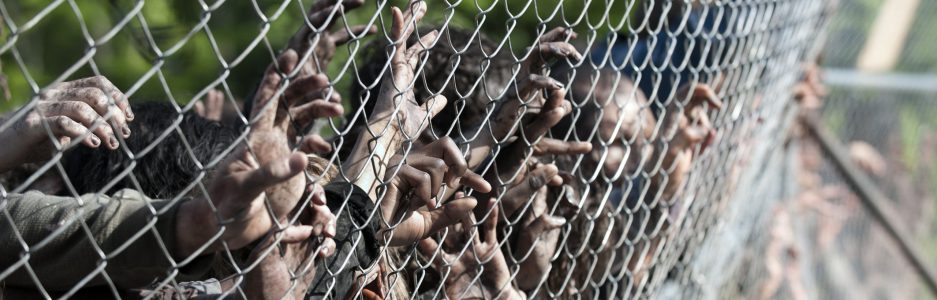
And yet, there is an equally strong tendency in both verbal non-verbal Zombie narratives to strip away the veneer of social discourse and the legitimized forms of communication so as to expose the human subject in all of his/her corporeal vulnerability. In other words, Zombie narratives don’t only foreground communities and institutions under duress, but the individual human organism as a body in crisis. This body is materialized in sound, in movement—it expresses itself beyond and before speech, beyond and before community, beyond and before history as a collective project or enterprise. This subject-that-is-not-a-subject (since it is beyond and before subjectivity) is both highly individualized—that body in that situation—and general—it has in common with all human bodies what those bodies require, relish, seek out, as well as what they reject, refuse or simply must endure as part of their continuance. To foreground the survivor’s body in this way is to risk dissolving the ideological boundary between the survivor and the Zombie who, in a real sense, is all body. It is also to open up a thinking of ‘the human’ and community outside—even against—speech, communication, and history.
One way to bring this proto-subject into view is by temporarily disregarding what it says to focus instead on what is emitted from its body as non-semantic, non-utilizable sound. To focus on the voice of the survivor is always to define the survivor as a social being whose meaning and identity derive from its participation in a definable enterprise or its membership or potential membership in what Aphonso Lingis calls the “rational community.” Lingis writes:
The production of rational discourse transforms action. Actions driven by mute drives and cravings of one’s own are transformed into actions motivated by reasons, which, as reasons, are not one’s own, and solicit the assent of others. Such initiatives can enlist the efforts of others in common motivations [because of the abstract character of reasons] and become collective actions. Each one invests his or her forces and passion in enterprises that absorb and depersonalize him and her and that endure and go on working or disintegrate without him or her. When we view enterprises in the public field…we explain them with reasons which belong to no one and everyone” (“The Other Community” 5).
But to attend to the sounds that interrupt rational discourse is to discover the intimations of an ‘other’ identity and an ‘other’ community that cut across our usual categories and compartmentalizations, an identity based on what our bodies “have seen and heard, what [they] can vouch for” (Lingis “Carrion Body, Carrion Utterance”), a community which can no longer exclude all those life forms which had been denied membership in the human community for their lack of speech—a community of life.
From one perspective, because this is a notion of the ‘subject’ in which speech has lost its priority and a notion of ‘community’ outside communication, the space separating human and Zombie begins to collapse. If we look at the first omnibus volume of Kirkman’s The Walking Dead comic (issues 1-6), we can set what issues from the mouths of the Zombies alongside what issues from the mouths of the human survivors in moments of crisis.
ZOMBIES PEOPLE
uungh un un un
guk oof
glaak heh
guh huh
gar hwaag
ruh agh
ruoaugh uff
guh aaugh
huh blaag
grr gaahh
rrgh gah
ruugh yeargh
whugh ahh
augh grrr
gruh gak
wuag guk
uhh uhh uhh ack
Even in a work as comfortable with the categorical distinction between human and Zombie as The Walking Dead, there is something materially inscribed here at the level of bodily sound that belies that easy confidence. Registered here in the right-hand column is a speaking of the (human) body that responds to and echoes the non-human sounds of the Zombie: indeed, at certain moments, the survivor and the zombie seem to be speaking the same (non) language (“guk”). These sounds assert a commonality that underscores the creaturely, instinctual, a-rational, animal dimension of being human that is easier to ignore when human figures appear to us as competent users of language, with articulated values and shared plans. What are the rights of a body, as body? Can we begin to ask that question? Outside citizenship, membership, ownership, even companionship, might there be a latent politics of the body here that cuts across the human/Zombie (and therefore also human/animal) divide? What would a Zombie narrative look like that began by asserting the commonality of “carrion” bodies, our “poor” bodies of “Muscle and blood and skin and bones”?
For Lingis, to emphasize our own carrion bodies is to discover our commonality and interdependence with non-human creatures and with the living, dying world as a whole. Talking about the sound poetry of Cathy Berberian, Lingis argues that her irrational noisemaking “exposes her sensibility, her susceptibility, her mortality, and the flux and scope of her carnal existence” (“Carrion” 92). Likewise, David Appelbaum aligns bodily sounds and vocal noisemaking with “[t]he corporeal intelligence [that] knows directly of creaturely death with its power to interrupt life at any stroke” (11). In sounds like “guk” or “gaahh” or “yeargh,” Lingis and Appelbaum hear the call of mortality, a reminder of death that the mainstream tradition of Western metaphysics, with its emphasis on communicative speech and reason, has sought to repress. In repressing this, philosophy has simultaneously denied our kinship with other dying creatures. In the Zombie’s “guk” we are reminded of our own creaturely, corporeal existence.
But Zombies are not alive; they do not die. Above, I said we can think of Zombies as being “all body.” But it is just as true to say that a Zombie has no body as such, since it cannot experience pain or death. Our possible kinship with the Zombie is constrained, necessarily, by its immortality: the Zombie is a body without “susceptibility;” where there is no precarity there is no life either.
From the perspective of the sounding body, there is still a line to be drawn between humans and Zombies, but it follows a different logic than that to which we are accustomed: this line no longer separates consciousness from unconsciousness, speech from non-speech, rational being from non-rational being, but differentiates between bodies that suffer and delight and bodies that don’t, bodies that die and bodies that don’t. If there is a value in the possibility of our thinking this way, it has less to do with our understanding of Zombies, than with our capacity to imagine our kinship with the plurality of living beings outside the limited humanist community of speech and reason.
Fellow travellers: Alphonso Lingis, David Appelbaum, Cathy Berberian, Merle Travis
Stops along the way: The Walking Dead, Vol 1.
 Thoughts on Zombies