Presented at Concordia University’s SpokenWeb Symposium on “Listening, Sound, Agency,” May 21st 2021.
Today, I want to talk about zombie sounds. There’s a visual bias to most discussions of the zombie in popular culture. Fan discussions often focus on the special effects that are involved in representing the undead in their various states of decay; zombie makeup artists and effects coordinators like Tom Savini and Greg Nicotero are often better known than the directors on whose projects they work. More theoretical discussions—there is now a whole field of zombie studies—will often invoke affective categories like disgust or abjection but generally focus on the same visual elements that signify the repulsive body.
Of course, the zombie is a uniquely visual monster; it’s a creature of comic books, and film, and television and video games. It doesn’t have the literary provenance of vampires or ghosts, for instance, but was born in visual media. On the other hand, tv shows, movies and video games are audio-visual media, and even the comic book tends to register sound in a very visceral way—Bang! Pow! Oof!—so I want to redress what I see as an imbalance and consider the very crucial role that sound plays in representing the zombie. More precisely, I want to think about how the sounds a zombie makes shape or condition its meaning for us, a meaning that is perhaps more complicated and more interesting when we do think about its vocalizations.
But I need to start with a little housekeeping: there are different kinds of zombies belonging to distinct traditions and which perform different sorts of cultural work. There are 2 primary binary oppositions that account for the various ontological, or “zontological” possibilities of the genre. Firstly, a zombie is either a supernatural object or it is a scientific object—that is to say, the zombie’s affliction either has an otherworldly, magical cause like a curse or a spell, or it has an ostensibly realistic, natural explanation like toxic waste or radiation or a virus. Secondly, the zombie is either verbal or non-verbal; it either speaks, or is capable of speech, or can understand the speech of others, or it cannot. In the case of the verbal zombie, you get an agentic figure capable of having and expressing thoughts and feelings and capable of forming attachments and developing in some way. In the case of the non-verbal zombie you have an entity that is, as philosopher David Chalmers puts it, “all dark inside.” Zombie theorists Lauro and Emby refer to the non-verbal zombie as an “anti-subject.” I just read a novel in which this kind of zombie was referred to as the “ontologically departed” (Raising Stony Marshall).
For today’s talk, I’m going to limit myself entirely to the scientific non-verbal zombie. Importantly, its in relation to this zombie type that we first see what is now the dominant zombie paradigm, that is to say the 3 Cs: Contagious Cannibals who Congregate. And its this recipe that most handily lends itself to a survivalist narrative, which is really what most zombie comics, films, shows and games are about these days.
Now it’s part of the inherently conservative nature of these narratives to construct the zombie antagonist as wholly Other. Most contemporary zombie narratives featuring the scientific non-verbal type are predicated on a categorical difference between humans and zombies. The whole point is that the zombie doesn’t count as an ethical or political subject and can be murdered with impunity. The dominant appeal of this zombie, in fact, is its mass killability. In Levinas’s terms, this zombie is an other “without a face”; an unrecognizable other, it makes no demands upon us as moral interlocutors.
Crucial to its representation in this respect is its speechlessness, its inability to engage in symbolic discourse. Not all zombies in this type experience a death of the body, but they all experience a death of self, of individual consciousness. Even in those narratives where the death of the body is ambivalent or paradoxical, the loss of subjectivity is definite and uncontentious. Over and over in the contemporary zombie narrative, the loss of consciousness, of identity, of agency is staged as loss of language.
Let me play you a sound clip from Danny Boyle’s 2002 film 28 Days Later.
This moment when an articulate loved one transforms into an inarticulate monster recurs so frequently in the zombie text that we should regard it as what Jameson calls an ideologeme, a repeatable chunk of narrative that represents the ideological kernel of a text. There is a definite social process taking place here when Selena, the second female voice you hear, says to Jim, “he’s infected” followed almost immediately by “Kill it.”
One way to read the moment of translation from human to zombie is as a collapse into animality. Indeed, the oldest and most powerful way to establish human sovereignty has been by way of a contrast with animals precisely because an animal is thought to lack the linguistic competence to say “I” and therefore be a subject with all its rights and privileges.
The concept is to some extent literalized at the level of production. While the basis of most zombie vocalizations remains the human voice, sound producers very often splice in animal noises to render those vocalizations more alien and predatory. For instance, Peter Brown who did sound design for both World War Z and A Scout’s Guide to the Apocalypse, used dogs, jaguars, wild boars, and wolves to fill out the sounds of the zombies.
In a sense, the ideologeme here is meta-ideological insofar as it establishes the conditions for politics as such. For Jacques Ranciere, politics has always been about the erection of a boundary separating the sound of “our” rational discourse from the senselessness of “their” noise. And, indeed, zombies, structurally speaking, occupy a place in narratives of besiegement that were once occupied by indigenous peoples as well as animals.
But its also true that no community can be established without boundaries of some kind. There is an obsessive but obviously practical attention in zombie narratives to the finding, constructing, and preserving of defensible barriers, where the wall or fence literally separates the human from the non-human. To the extent that the community can preserve the integrity of its borders, they can aspire to a post-capitalist and post-racial society. There’s a moment in The Walking Dead where Rick says there’s no black and white anymore, there’s only the living and the dead. Here we see the zombie helping us deliver on the promise of humanism that’s been perpetually denied by history.
But my point is that the boundary between the human community of survivors and the zombie horde is also a sonic one. It is not enough that the zombie merely lack language; the zombie has to sound its difference. So strong is the social desire to hear the zombie’s inhumanity that it overrides the fact that zombies don’t breath and therefore shouldn’t be able to produce these sounds. In other words, zombies only take air into their lungs in order to vocalize and they do so for purely artistic—that is to say cultural and political—reasons.
Let me play you some clips
So I’ve tried to cover the gamut of zombie utterance: you’ve got your moaners, your groaners, your grunters, your growlers, your grumblers, your shriekers and your howlers. These vocalizations signify that the zombie exists beyond or rather before the usual categories of identity. For instance—we just heard male and female, adult and child, German, Korean, Australian, Indian, and American zombies, but none of those identities obtain as relevant designators for these creatures.
As the clips demonstrate, the sonic representation of zombies as “whats not whos” repeatedly depends on allusions to the animal world. At the same time, these texts rarely treat animals to the same violence that is inflicted upon the zombie. Zombies remind us of animals, but they are actually less than animals. They are less capable of communication than even the least sophisticated creatures. Ants communicate, whereas the operations of zombies are uncoordinated and entirely Newtonian, which is why they tend to collect at the bottom of hills. Leopards and wolves are capable of guile, of voluntarily suppressing their sounds when pursuing prey, but there’s something explicitly involuntary and autonomic about the zombie’s vocalizations. Animals are capable of recognizing kinship and sometimes live in highly complex social arrangements. Zombies express a negative sociality; they congregate and mass, but as atomized entities merely responding to a stimulus.
In the tradition I’m talking about, the zombie is a body without—without consciousness, without feeling, without identity. The zombie is a body without belonging. As Jeffrey Cohen writes, zombies are “nothing but their bodies.” But whose body? For all of its otherness, the zombie has a human form. There’s a paradox here: “Despite its human form,” writes Cohen, “these undead are far less anthropocentric” than other monsters. It is not despite the fact that the zombie is a human corpse that we insist on its facelessness, but because of it. Lauro and Embry write, “The zombie is the perishable carnality that we hide from ourselves, the declaration of our own thingly existence.
If as Steven Shaviro suggests, “zombies are, in a sense, all body,” that condition is recurrently expressed through sound, specifically non-semantic vocal utterances. We know from the tradition of sound poetry that the recuperation of non-semantic sounds as the stuff of oral performance is tied to a politics of reclaiming a repressed organic body. The sound poet growls and shrieks and groans and hisses in order to remind the listener that speech has its foundation in the body. The similar noises of the zombie suggest that the zombie is not merely a corporeal figure but a figure of corporeality as such. In other words, the zombie is a MEATAPHOR; it represents our carnality, the mortal corporeality we share with all living creatures, but which we denigrate and suppress as a sign of our humanity. To kill the zombie, to interrupt its noise and then to talk about it, is therefore to enforce the strictest sort of hygiene in which the human, the rational, and de-corporealized speech all line up.
And yet, and yet, the aural ecology of the zombie text contains the very elements that might allow us to disturb this hygiene in a potentially productive way. Despite the aggressive humanism of the type of zombie narrative I’m describing, there is still this tendency to strip away the veneer of civilized social discourse so as to expose the human subject in all of his/her corporeal vulnerability. In other words, Zombie narratives don’t only foreground communities and institutions under duress, but the individual human organism as a body in crisis. This body too is materialized in non-verbal sound—in grunts, screams, sobs, sudden inhalations. We heard many of these sounds in the audio I just played.
To focus on the speechified voice of the survivor is always to define the survivor as a social being whose meaning and identity derive from its participation in a definable enterprise or its membership or potential membership in what Aphonso Lingis calls the “rational community.” But to attend to the sounds that interrupt rational discourse is to discover the intimations of an ‘other’ identity and an ‘other’ community that cut across our usual categories and compartmentalizations, an identity based on what our bodies “have seen and heard, what [they] can vouch for” (Lingis “Carrion Body, Carrion Utterance”), a community that no longer excludes all those life forms which had been denied belonging for their lack of speech.
To illustrate: If we look at the first omnibus volume of Kirkman’s The Walking Dead comic, we can set what issues from the mouths of the Zombies alongside what issues from the mouths of the human survivors in moments of crisis.
Even in a work as confident in and comfortable with the categorical distinction between human and zombie as The Walking Dead, there is something inscribed here at the level of bodily sound that belies that easy confidence. Registered here in the right-hand column is a speaking of the (human) body that responds to and echoes the non-human sounds of the Zombie: indeed, at certain moments, the survivor and the zombie seem to be speaking the same (non) language (“guk”). These sounds assert a commonality that underscores the creaturely, instinctual, a-rational, animal dimension of being human that is easier to ignore when human figures appear to us as competent users of language, with articulated values and shared plans.
For Lingis, to emphasize our own carrion bodies is to discover our commonality and interdependence with non-human creatures and with the living, dying world as a whole. But Zombies are not alive and they do not die, but merely cease. I said we can think of Zombies as being all body. But it may be just as true to say that a Zombie has no body as such, since it cannot experience pain or pleasure. David Appelbaum aligns bodily sounds and vocal noisemaking with “[t]he corporeal intelligence [that] knows directly of creaturely death with its power to interrupt life at any stroke” (11). In sounds like “guk” or “gaahh” or “yeargh,” Lingis and Appelbaum hear the call of mortality, a reminder of death that the mainstream tradition of Western metaphysics, with its emphasis on communicative speech and reason, has sought to repress. In the Zombie’s “guk” we are reminded of our own creaturely, corporeal existence. But our possible kinship with the Zombie is constrained, necessarily, by its inorganicism: the Zombie is body without “susceptibility,” and where there is no precarity there is no life either.
From the perspective of the sounding body, there is still a line to be drawn between humans and Zombies, and if one shows up on your doorstep, you should definitely kill it.
But this boundary has a new logic; it no longer separates consciousness from unconsciousness, speech from non-speech, rational being from non-rational being, but differentiates between bodies that suffer and delight and bodies that don’t, bodies that can give and receive comfort and bodies that can’t, bodies that die and bodies that don’t. If there is a value in the possibility of our thinking this way, it has to do with our capacity to imagine our kinship with the plurality of living beings outside the limited humanist community of speech and reason. But additionally: to think community up from the precarious but joyful body instead of down from the abstractions of national, ethnic, racial or ideological identity is also to put in doubt the politics of the survivalist narrative in which human beings battle each other with almost as much enthusiasm as they kill the zombie.
7(a) The First Law of Thermodynamics is the law of the “Conservation of Energy,” which asserts that energy can neither be created or destroyed in a closed system. Energy can be converted from one form to another through a variety of chemical, electrical or physical processes, but only at the cost of the transformation of the initial system or by way of the introduction of outside energy. In other words, an object—a machine or a body, for instance—cannot generate force or do work and remain constant without the input of energy from an external source. It’s this First Law that makes perpetual motion a theoretical impossibility. Machines need some form of energy input to move and affect matter; animal and human bodies need food, which we convert into energy, which we use up when we walk, talk, think and shovel dirt. In other words, the First Law invalidates any possibility of getting something for nothing, at least when that something is work. (Work, in this sense, is the application of force on objects so as to effectuate their change or transformation; it’s the power that meets and overcomes the stubborn resistance of matter.) Just a few moments ago, I called my industrious wife, on her way downstairs for yet another Zoom meeting ‘a perpetual motion machine.’ ‘No, I’m not,’ she replied, ‘I require cheese.’ Which is what got me thinking about this.
In the lion’s share of popular representations, Zombies appear to contravene this very basic law. They may want to eat your brains, but they don’t need your brains (or food of any kind) to keep shuffling about. One way of differentiating rage-plague narratives from Zombie narratives proper might be to determine whether or not the creatures respect or defy the First Law of Thermodynamics. In 28 Days Later, for instance, the infected eventually wind down in the absence of fresh meat. In The Walking Dead, on the other hand, zombies who don’t even have stomachs anymore drag their derelict bodies after any living thing. (What drives the Zombie is an interesting question, but here I’m more interested in what powers it, which is a related, but separate issue.) It is interesting to note that the contemporary Zombie remains an object of science and realism, even though its basic ontology contravenes a cardinal scientific law.
In his book The Human Motor: Energy, Fatigue, and the Origins of Modernity, Anson Rabinbach traces the profound transformations in philosophy, politics and public discourse occasioned by the discovery and acceptance of the new science of thermodynamics, the origins of which lie in the mid-nineteenth century. One of consequences of this new science was the displacement of moralistic and religious ways of talking about personal and social non-productivity in favour of more mechanistic and ‘objective’ approaches. The problem with workers (especially those increasingly brought within the orbit of industrial processes) was not laziness or moral lassitude but fatigue. It was a question of energy, not will. (Of course, the problem was also will, but energy was more easily tackled without having to question the overall system itself.)
The discovery of fatigue as an unsurpassable human limit (but a constraint shared by all energy consuming systems, organic and inorganic alike) threw into sharper relief the implicit goal of earlier experiments in automata (like Jacques de Vaucanson’s Canard Digérateur [The Digesting Duck].) In their desperate attempt to create living machines, didn’t all these craftsman, Rabinbach suggests, ultimately “envision a body without fatigue, without discontent, and without an aversion to work?” (57). “The dream of the builders of automata was ultimately premised on a redemption from labor” (58). To put it another way, it was a born of a desire for work without labour—and labour power without labourers. It was not a quest to transform the experience of human labour—as pursued by William Morris and other socialists—but to exempt humans from labour, which was best left to less fragile, and less capricious, devices. Rabinbach quotes 19th century physicist and physician Herman von Helmholtz, one of the great popularizers of thermodynamic theory of his day:
“…still there would be many who would be willing to dispense with the moral qualities of their servants, if at the same time their immoral qualities could also be eliminated, and to achieve instead of the immutability and flesh and bones, the regularity of a machine and the durability of brass and steel.” (in Rabinbach 58).
For Helmholtz, the mistaken assumption of the automatists was not in hoping that robots could or should take up a greater role in production, but that they remained beholden to an organicist and ultimately humanist view of the worker. What was needed was a more systematic view of production—and a division of labour that did not organize people as discrete subjects, but circumvented the limitations of the person as such:
“We no longer seek to build machines which shall fulfill the thousand services required of one man, but desire, on the contrary that a machine shall perform one service, and shall occupy in doing it the place of a thousand men” (in Rabinbach 58).
And so we arrive, eventually, at what economists are calling the ‘end of work’, as automation displaces increasing numbers of workers in a system that still requires one to have a job if one wants to survive with any dignity.
But I was talking about perpetual motion. The interest in automata was closely linked with the quest for a perpetual motion machine. Could one of these uncanny piano playing dolls eventually be made such that it fueled itself? And while the new theory of thermodynamics enabled the desires of the former to carry on in the logics of industrial efficiency and maximal productivity, it absolutely put the lie to perpetual motion. Rabinbach:
“Even the elimination of ‘labor’ by the machine could never dispense with the requirement for labor power. By extending the idea of energy to all aspects of inorganic and organic experience, the theory of the conservation of energy permitted the old phantom of perpetuum mobile to be exorcised” (58-59).
While it may not be an affront to science think that the human being could be exempted from labour, it was sheer delusion to think that labour power—work—could be obtained without the consumption of resources. Fatigue, which was was merely the human experience of the First Law, motivated a desire to escape or minimize energy expenditure in labour; the same law asserted that all work had its costs. Helmholtz’s pronouncement on this question was unambiguous:
“Perpetual motion was to produce labor power inexhaustibly without corresponding consumption, that is to say, out of nothing. Work, however, is money. Here emerges the practical problem which clever people of all centuries have pursued in the most diverse ways, namely to create money out of nothing. The comparison with the philosopher’s stone sought by the ancient alchemists is complete” (in Rabinbach 58).
It is not difficult to see in the Zombie’s lack of fatigue the symbolic realization of the desires of both the automatists and the quixotic seekers of perpetual motion. By contravening the First law of Thermodynamics, Zombies might enable a total reimagining of both work and political economy. The fact that this possibility has not been taken up in contemporary Zombie narratives in any sustained or serious way is almost as interesting as the limited ways in which it has. Why, on the whole, have Zombies not been imagined as fleshy robots—fleshbots (I just googled ‘fleshbot’ and apparently it’s the name of a porn site, but I’m going to stick with it anyway)—which, unlike actual robots, don’t require the investment of any capital for their continued operation?
The capitalist fantasy of pure surplus value, of profit without investment, is certainly at work in the Caribbean zombie tradition in which plantation workers, after a life of indentured servitude, are resurrected and compelled back into the fields. From the point of view of the plantation owners, slaves are better than wage laborers, and slaves you don’t have to clothe or feed are the best of all. Most treatments of this folk tradition have focused on its colonial and racist dimensions. The workers are always black, and in the case where a white person is threatened with zombism, the danger is not only existential, but carries with it a clear racial and class penalty. There is a long history of colonization in play here that generated the political and social factors that produced and maintained (I should say produces and maintains) a racialized work force throughout the Caribbean, and elsewhere. This process is reified in the form of the Hatian voodoo Zombi who, unlike the mass Zombie of contemporary narratives, is selected by a specialist of some kind (evil plantation owner, mad scientist or voodoo priest) in such a way as to keep the racial lines of the labour force consistent. Some of the workers are alive, some are dead, but all of them are black. In the film White Zombie (1932), usually considered the first zombie feature, the Voodoo master Murder Legendre also owns a sugar mill in which Zombis power the machines and perform manual tasks like sorting and hauling.
Purely in terms of productive capacity, though, the racial identity of the zombie is irrelevant: labour power is labour power. In a capitalist or mercantile context, labour power is, as Helmholtz reminds us, money, and money is non-specific. But the real exercise of capital is never pure. We can bring in the Marxist idea that while labour power is the ultimate source of all value, work is a social process through which the given world, with its divisions and hierarchies, is created or recreated. We can see, then, that films like White Zombie expose work at both levels: the Zombie, being black, reproduces the social conditions of postcolonial Haiti (a racialized division of labour) even as its labour power produces surplus value. In this case, the surplus value, appropriated by the (white) ruling classes, likewise reasserts the prevailing cultural and political logic adhering to the plantation system.
Even so, there is a utopian element inherent in the notion of undead labour power that the postcolonial and racial interpretations tend to obscure. (In all fairness, though, that’s what these narratives are about: an institutionalized racism from which not even the dead are spared.) When, however, the Zombie is not selected, but generated through indiscriminate mass infection, its potential labour power is made more abstract, stripped of its particularities. (Though, if Covid has taught us anything it’s that the risks of contagion are not evenly distributed, but are disproportionately borne by those who already socially and economically vulnerable.) The film Fido aligns itself with the earlier tradition insofar as it presents Zombies as unpaid workers—domestic servants, delivery people, sex-slaves, and factory hands. But it eliminates the selectivity and racial particularity of the voodoo Zombi, and situates itself securely in the domain of mass zombification. But despite the more indiscriminate and universalizing nature of its disaster, Fido cannot explore or must suppress the potentially liberating advent of Zombie labour power—precisely because it focuses not on labour power, but on the Zombies as workers, as individual subjects, who experience their labour and social position as alienating and, ironically, de-humanizing. By endowing its Zombies with memory and feelings, the film presents the Zombie, individually, as a victim and, collectively, as an oppressed class. In Romero’s Land of the Dead (2005), the proletarian politics are made explicit; Zombies develop a class-consciousness and rebel against their exploitation, incarnated in the mob boss/feudal lord Kaufman. Whereas the plantation Zombi does not know it’s oppressed (the best false-consciousness is a non-consciousness), the industrial age Zombies of Fido and Land of the Dead feel that oppression in their very bones, so to speak. In both cases, though for different reasons, we are encouraged to despise the social division of labour because it represents a continuity with, not a departure from, a status quo we find objectionable. This is further enforced by the uniform depiction of the users of Zombie labour as evil or corrupt. (Another example of this characterization is Squire Hamilton who uses zombified locals to toil in his tin mines in Plague of the Zombies.)
Yet White Zombie and Plague of the Zombies are now outliers when we look at the prevailing tendencies of the genre today. Historically, the plantation Zombie or the voodoo Zombi has been almost entirely displaced by the contagion Zombie. Stories in which the Zombie has been incorporated into a society whose systems and norms remain mostly unchanged are few and far between (Maggie,The Cured, I-Zombie, and In the Flesh, are some examples, though, alas, Disney’s Zombies 1 and 2 are probably the best known of this type.) There is a strong tendency in these narratives for the Zombies to be agentic, self-determining—or potentially self-determining–subjects. Fido is a rare example of the contagion zombie also having a personality. More typically (The Walking Dead is the ur-text here) not only is the Zombie part of an undifferentiated mass, particular Zombies have no discernible feelings or memories, no subjectivity, no language, no consciousness, no particular skills or abilities (One never hears, ‘Oh, this Zombie sings beautifully’ or ‘I met a Zombie today that writes code.) Such a figure can never be repressed; it cannot be alienated from anything it does, because there is no human potentiality being squandered. One cannot feel bad for such an entity, any more than you can feel bad for your toaster, or a rock. The prohibition against torturing Zombies that runs so strongly through the contemporary tradition is entirely a matter of decorum. Furthermore, most Zombie narratives present their disaster as global and apocalyptic; capitalism has been destroyed at its local, national, and planetary scales, thereby throwing the world into a precapitalist (and usually pre-industrial) mode of relations. One of the consequences of this is that all labour power has been liberated from the profit motive and the capitalist divisions of labour. The need for work remains, obviously, but the social production of labour—which hitherto had produced alienated workers and the class system itself—has been nullified.
As philosopher and cyberneticist Norbert Weiner has written, à propos of robots, “the automatic machine . . . is the precise economic equivalent of slave labor. Any labor which competes with slave labor must accept the economic conditions of slave labor” (The Human Use of Human Beings 220). Zombies are like robots insofar as they work for free, do not require much investment of resources, have no need to rest, and have no subjectivity, no spirit, no humanity that is deserving of recognition or concern. But they are not like slaves at all because they are not subject to or constitutive of a capitalist or white-supremicist economic and social order. Or to put it another way, they are slaves only to the extent that they can be imagined as political subjects or human agents, which almost everything in their representation militates against. The only logical arguments against their being used as an endless supply of energy, as pure labour power, would have to be couched in post-humanist terms–and the Zombie narrative is overwhelmingly humanist in its tendencies.
The stage has been set for a materialist, progressive, and wholly pragmatic view of the Zombie as free energy, the ‘philosopher’s stone’ of productive capacity and the generation of use values. Requiring no investment, incapable of fatigue—or less humanistically, able to “produce labor power inexhaustibly without corresponding consumption” (Helmholtz, above), the Zombie is, or could be, the enabling condition of paradise on earth. Given that the single greatest problem in most survival scenarios is scarcity, coupled with extreme physical and emotional fatigue, you’d think the existence of an unlimited source of energy within pitchfork’s reach would prove attractive. Certainly, chaining a few zombies to a treadmill and dangling a cat or small child in front of them could heat a greenhouse or electrify one’s security fence. Sure, it’s a little dangerous, but so is nuclear power.
And yet the positive utopian potential of Zombie power has not been explored in any Zombie narrative I can think of. Despite the absence of the structures that would render Zombie labour exploitive (as in White Zombie or Land of the Dead), the users of Zombie power in the contemporary tradition are still usually antagonists like the Whisperers in The Walking Dead who wield zombie hordes like a bunt force instrument against the enclosures of their enemies. (A similar idea is presented in The Girl With All The Gifts.) In fact, we could say that the prohibition against instrumentalizing the Zombie, individually or collectively, amounts to a generic rule that links all Zombie stories, notwithstanding the significant ruptures and transformations in their content and social context. In the (lousy) sort-of finale to season ten of the The Walking Dead, Carol and Lydia lead a stadium-sized horde off a cliff. Good guys waste the Zombies, bad guys use them.
If one of the hopes of modernity had been to free the individual from the curse of labour—manifested in the early experiments in automata and the quest for a perpetual motion, and later transmogrified into the rationalization of industry and the automation of production under capitalism—then there is something peculiarly antimodernist in the mainstream Zombie tradition which lays perpetual motion and free energy at its own doorstep only to reject it. I have examined aspects of that antimodernity in other entries on this blog. The narrative investment in differentiating labour from labour power in contemporary zombie novels and films is clearly a statement against rationalization and instrumentalization and the loss of individuality these entail. Characters are depicted as workers of various kinds, and work is ultimately ennobling and productive of community (as opposed to society, which was invented in modernity alongside the combustion engine and electricity.) One of the discoveries of the Zombie narrative, and a valuable one, is that in the absence of capitalist systems of control and the division of labour, work can be non-alienating. Except for the conspicuous absence of artists and artistic labour in these narratives, they share the same goal as Morris’s News From Nowhere, which is to assert that work is at the centre of personal and communal fulfillment, but can only serve that purpose when not subjected to rationalist control and the division of labour—when, in fact, a quest for labour power does not supercede the integrity and freedom of the worker him/herself. (I wish it were so; it only requires the destruction of the world as we know it for this to obtain.)
And yet, the Zombie’s narrative investment in its own conditions of scarcity (lack or resources, food, shelter, tools and machines), concomitant with its rejection of free Zombie energy, does raise the question whether its critique of instrumentality, which, alongside the apparent hatred of invention and techne, of science more broadly, that it shares with other anti-progressivist ideologies, is rather more reactionary than utopian in spirit. Like the characters in Morris’s News From Nowhere, the characters in most Zombie narratives are no longer alienated in their work, but unlike denizens of Morris’s socialist utopia, neither are they happy.
(Note: I have not admitted here the obvious corruptibility of the Zombie—it rots, and so it’s not entirely an infinitely renewable energy source. I will address this in my next post, which takes on the Second Law of Thermodynamics, that is, the law of entropy and the inevitable loss encountered in any transfer of energy.)
Fellow travellers: Anson Rabinbach, William Morris, Norbert Weiner
Stops along the ways: White Zombie, Plague of the Zombies, The Walking Dead, Fido, Land of the Dead, The Girl With All the Gifts, News From Nowhere
A departure from my usual kind of post. I was teaching figurative language in one of my classes last week and I had them do a creative assignment. They had to compose a poem with an obvious conceit and which contained a given set of tropes–metaphor, personification, simile, metonymy, etc. In the interest of fairness, I figured (ha!) I ought to try the exercise myself. So I came up with a situation: my lover has turned into a zombie; a conceit: the zombie woman is described in terms of a tree and tree-things; and a form: a blazon, which here happened to result in a sonnet. I had hoped that this might be the first poem of its kind, but there is a near precedent. Last year a guy named Chase Pielak published a book called The Collected Sonnets of William Shakespeare, Zombie (McFarland, 2018). In it, he tweaks Shakespeare’s sonnets so as to de-repress their latent zombie content, and provides a frame narrative (Shakespeare died [undied] a zombie) and critical apparatus. A great idea, inspired I’m sure by Pride and Prejudice and Zombies, but no less clever for that. But it has occurred to me that poetry remains the last frontier for zombie-themed writing. We have zombie novels, short stories, plays, and movies, but few, if any, zombie poetry collections or long poems. Obviously, lyric is a bit of a problem when the zombie is a zombie precisely for its lack of subjectivity, but that just leaves open more interesting kinds of poetry to employ. Anyway, it’s Halloween, and love is in the air. Here’s a zombie poem.
My Lady Doesn’t Look Herself Of Late
Her eyes are rotted cherries thumbed against a bole.
Her mouth but splinters stuffed into a hole.
Her cheeks are missing, bark fallen to the ground;
Her nose a knot, a welt, a borer beetle’s mound.
Mold upon her chin that spreads along her throat,
Wraps her twisted trunk in its fungus coat.
Once breasts now nests of foetid cankered sores
And blood like sap oozes from her pores.
Her arms are branches, handshake full of thorns.
She cannot sing or laugh, nor celebrate nor mourn,
Only shriek and hiss, grumble, moan and howl,
For death is grafted to her heart; her very roots are foul.
Oh love: don’t hide yourself behind that murdered tree;
Take my hand and kiss me deep and make me one with thee.
Some people say a man’s made out of mud
A poor man’s made outta muscle and blood
Muscle and blood and skin and bones
A mind that a-weak and a back that’s strong
—Merle Travis, “16 Tons”
In Section Two (‘Second Thought’) below I argue that it is the voicelessness of the Zombie that defines the ontology of the dominant modern form of the Zombie and which finally determines its meaning for us as an aesthetic and cultural figure. I argue that the transition from the human being defined as a ‘language animal’ to a mere animal (however unnatural in the conventional sense) represents for that subject a loss of personal and political identity as well as any legal/ethical ‘standing’ vis à vis the survivor society. Following Agamben, I define Zombie death as specifically the death of the voice, and with it subjectivity and its various entitlements. The consequence of such an argument (which I am anxious to problematize but not quite abandon here) is that it equates humanity with intelligible speech and therefore makes that humanity contingent on the social institutions and structures that determine and police that intelligibility. Speech, in other words, is a social, not just natural fact; it imbricates the subject, as speaker, within any number of systems outside it and it is within and as a consequence of these systems that the subject is recognised as a subject or not. The speaking subject is always the interpellated subject.
And yet, there is an equally strong tendency in both verbal non-verbal Zombie narratives to strip away the veneer of social discourse and the legitimized forms of communication so as to expose the human subject in all of his/her corporeal vulnerability. In other words, Zombie narratives don’t only foreground communities and institutions under duress, but the individual human organism as a body in crisis. This body is materialized in sound, in movement—it expresses itself beyond and before speech, beyond and before community, beyond and before history as a collective project or enterprise. This subject-that-is-not-a-subject (since it is beyond and before subjectivity) is both highly individualized—that body in that situation—and general—it has in common with all human bodies what those bodies require, relish, seek out, as well as what they reject, refuse or simply must endure as part of their continuance. To foreground the survivor’s body in this way is to risk dissolving the ideological boundary between the survivor and the Zombie who, in a real sense, is all body. It is also to open up a thinking of ‘the human’ and community outside—even against—speech, communication, and history.
One way to bring this proto-subject into view is by temporarily disregarding what it says to focus instead on what is emitted from its body as non-semantic, non-utilizable sound. To focus on the voice of the survivor is always to define the survivor as a social being whose meaning and identity derive from its participation in a definable enterprise or its membership or potential membership in what Aphonso Lingis calls the “rational community.” Lingis writes:
The production of rational discourse transforms action. Actions driven by mute drives and cravings of one’s own are transformed into actions motivated by reasons, which, as reasons, are not one’s own, and solicit the assent of others. Such initiatives can enlist the efforts of others in common motivations [because of the abstract character of reasons] and become collective actions. Each one invests his or her forces and passion in enterprises that absorb and depersonalize him and her and that endure and go on working or disintegrate without him or her. When we view enterprises in the public field…we explain them with reasons which belong to no one and everyone” (“The Other Community” 5).
But to attend to the sounds that interrupt rational discourse is to discover the intimations of an ‘other’ identity and an ‘other’ community that cut across our usual categories and compartmentalizations, an identity based on what our bodies “have seen and heard, what [they] can vouch for” (Lingis “Carrion Body, Carrion Utterance”), a community which can no longer exclude all those life forms which had been denied membership in the human community for their lack of speech—a community of life.
From one perspective, because this is a notion of the ‘subject’ in which speech has lost its priority and a notion of ‘community’ outside communication, the space separating human and Zombie begins to collapse. If we look at the first omnibus volume of Kirkman’s The Walking Dead comic (issues 1-6), we can set what issues from the mouths of the Zombies alongside what issues from the mouths of the human survivors in moments of crisis.
ZOMBIESPEOPLE
uungh un un un
guk oof
glaak heh
guh huh
gar hwaag
ruh agh
ruoaugh uff
guh aaugh
huh blaag
grr gaahh
rrgh gah
ruugh yeargh
whugh ahh
augh grrr
gruh gak
wuag guk
uhh uhh uhh ack
Even in a work as comfortable with the categorical distinction between human and Zombie as The Walking Dead, there is something materially inscribed here at the level of bodily sound that belies that easy confidence. Registered here in the right-hand column is a speaking of the (human) body that responds to and echoes the non-human sounds of the Zombie: indeed, at certain moments, the survivor and the zombie seem to be speaking the same (non) language (“guk”). These sounds assert a commonality that underscores the creaturely, instinctual, a-rational, animal dimension of being human that is easier to ignore when human figures appear to us as competent users of language, with articulated values and shared plans. What are the rights of a body, as body? Can we begin to ask that question? Outside citizenship, membership, ownership, even companionship, might there be a latent politics of the body here that cuts across the human/Zombie (and therefore also human/animal) divide? What would a Zombie narrative look like that began by asserting the commonality of “carrion” bodies, our “poor” bodies of “Muscle and blood and skin and bones”?
For Lingis, to emphasize our own carrion bodies is to discover our commonality and interdependence with non-human creatures and with the living, dying world as a whole. Talking about the sound poetry of Cathy Berberian, Lingis argues that her irrational noisemaking “exposes her sensibility, her susceptibility, her mortality, and the flux and scope of her carnal existence” (“Carrion” 92). Likewise, David Appelbaum aligns bodily sounds and vocal noisemaking with “[t]he corporeal intelligence [that] knows directly of creaturely death with its power to interrupt life at any stroke” (11). In sounds like “guk” or “gaahh” or “yeargh,” Lingis and Appelbaum hear the call of mortality, a reminder of death that the mainstream tradition of Western metaphysics, with its emphasis on communicative speech and reason, has sought to repress. In repressing this, philosophy has simultaneously denied our kinship with other dying creatures. In the Zombie’s “guk” we are reminded of our own creaturely, corporeal existence.
But Zombies are not alive; they do not die. Above, I said we can think of Zombies as being “all body.” But it is just as true to say that a Zombie has no body as such, since it cannot experience pain or death. Our possible kinship with the Zombie is constrained, necessarily, by its immortality: the Zombie is a body without “susceptibility;” where there is no precarity there is no life either.
From the perspective of the sounding body, there is still a line to be drawn between humans and Zombies, but it follows a different logic than that to which we are accustomed: this line no longer separates consciousness from unconsciousness, speech from non-speech, rational being from non-rational being, but differentiates between bodies that suffer and delight and bodies that don’t, bodies that die and bodies that don’t. If there is a value in the possibility of our thinking this way, it has less to do with our understanding of Zombies, than with our capacity to imagine our kinship with the plurality of living beings outside the limited humanist community of speech and reason.
Fellow travellers: Alphonso Lingis, David Appelbaum, Cathy Berberian, Merle Travis
“Monsters have always defined the limits of community in Western imaginations” (64), writes Dona Haraway in “The Cyborg Manifesto” (1991). This is unquestionably true. I have so far been interested in tracing the political possibilities and (generally hidden) ideologies set in in motion by texts within the non-sentient (‘all dark inside’) zombie tradition typified by The Walking Dead. I have had less positive, and admittedly less insightful, things to say about that other tradition, the talking zombie—or what Kyle Bishop calls the “agentic zombie” in his compelling essay about teachers and teaching in Carey’s The Girl with All the Gifts. Here, because they have language, consciousness, and will, Zombies are“agents:” self-aware and self-directed beings. By figuring what we might call the ‘non-human person’, TheGirl with All the Gifts challenges a humanist tradition in which personhood (and the ‘standing’ or privilege attached to it) is irrevocably tied to an unexamined (implicitly coherent, totalizing, centred) idea of ‘humankind.’
The Girl With All the Gifts is consequently engaged in what Haraway calls “category work” that poses the question of community within a broader questioning of humanity and the human. There is a way in which all zombie narratives promote a way of thinking that apprehends the human individual as the member of a species that takes its place (and takes up space) alongside and in relation to other species on a planet on which resources, including space for living itself, are finite. By the very antithetical nature of its plots, the zombie narrative constructs for ‘us’ a species identity that does not transcend so much as deconstruct other filiating categories such as nation, race and gender. At least potentially, the notion that ‘the fate of the entire human species is at stake’—explicitly uttered or implicitly felt in so many zombie stories—encourages a species view of human life, a view that we desperately need if we are to construct ecologically and politically viable (not to mention just) models for our continued planetary existence. Even so, it is also true that most non-sentient zombie narratives encourage this species view while simultaneously consolidating it around liberal humanist notions of ‘the person’, which usually entail clear-cut distinctions between self and other, human and animal, organic and inorganic, civilization (meaningful order) and wilderness (chaotic unmeaning), etc. Ironically, the very interstitiality of the figure of the ‘undead’ upon which these narratives are based generates narrative structures that are, generally speaking, highly intolerant of mixture, confusion, interpenetration, or métissage of any kind. An anxious object (or rather an object of [our] anxiety) the non-sentient Zombie motivates a thinking towards new forms of community and political organization but stops short of problematizing the ontological status or ‘nature’ of its subject-citizens by refusing to depart from already-established notions of humanity. Whatever new world it imagines emerging out of its apocalypse, it’s always a world by and for human persons.
This is, however, is less true when it comes to the talking or agentic Zombie which manifests what is sometimes called a dirty ontology. The Girl with All the Gifts, de-centres and relativizes the human person by introducing a third term to the typical binary structure of the zombie narrative, a second generation of zombie children who possess all the verbal and intellectual capacities denied their parents. In the book, zombies, on occasion, literally engage in ‘mindless’ sex (to go along with their mindless violence) thereby producing offspring who are clinically dead but are otherwise hyperbolically ‘human’ (hyperbolic because they are not only mentally and physically more capable than normal human beings, but possess an imaginative sympathy seemingly lost to a humankind pushed to the edge of extinction).
But the “gifts” in question are not so much these abilities but rather the stories—Greek myths and children’s classics—that the main character Melanie has been taught by her teacher Miss Justineau. Crucially, these stories persist, are carried into the future, as world-(re)building metanarratives but not by human beings, who by the end of the novel are extinct, but by a generation of quasi-zombies who are explicitly, emphatically, not human. The novel produces a paradoxical situation in which human history carries on past the end of humanity itself: its continuity depends on a radical discontinuity and substitution at the level of the historical subject; whatever history is—potential, growth, emergence, change-in-time —it isn’t for (or about) humans anymore. The provocative point of the novel is that humans have squandered their inheritance; they don’t deserve to survive, even if their stories do.
Having triggered a massive release of the fungal spores that turn humans into the undead “hungries,” thereby killing off the earth’s few remaining embattled (and battling) survivors, Melanie explains:
It’s terribly, terribly sad for the people who get it first, but their children will be okay and they’ll be the ones who live and grow up and have children of their own and make a new world. “But only if you let them grow up,” she finishes. “If you keep shooting them and cutting them into pieces and throwing them into pits, nobody will be left to make a new world. Your people and the junker people will keep killing each other, and you’ll both kill the hungries wherever you find them, and in the end the world will be empty. This way is better. Everybody turns into a hungry all at once, and that means they’ll all die, which is really sad. But then the children will grow up, and they won’t be the old kind of people but they won’t be hungries either. They’ll be different. Like me, and the rest of the kids in the class. “They’ll be the next people. The ones who make everything okay again” (399).
The theme of restoration here does give one pause, as it seems rather indebted to a myth of return or of ‘paradise regained’ which critics from Jean-Luc Nancy to Haraway have identified as one of the mythological projects through which human beings have asserted their sovereignty over and against every other living organism on the planet. But that’s part of the novel’s strange telos: the stories and frameworks carry on as the intellectual machinery of another species which has appropriated them for their own purposes. The “next people” are not human beings. They are fundamentally “different.”
But the Zombie kids aren’t really that different —or aren’t quite different enough. In “The Cyborg Manifesto,” Haraway mentions Katie King’s observation that when it comes to experimental feminist science fiction, readerly pleasure does not depend on one’s identification with the figures or characters that embody the texts’ category-confusions. But we all-too-easily identify with Melanie in The Girl With all The Gifts. Yes, she doesn’t need oxygen and blood doesn’t actually circulate in her veins, but for all intents and purposes she’s really just a very pale ‘human’ being. What had initially seemed to be an attempt to think through species, in the end turns out to be rather more generational than ontological in its displacements. The “next” people still seem an awful lot like people. (When I taught this book to my undergrads I started the class by playing Whitney Huston’s “The Greatest Love of All,” which too easily expresses the theme of the novel: “I believe the children are our future; teach them well and let them lead the way….”).
A zombie movie that comes closer, in my thinking, to producing the discomforts proper to a genuinely ‘dirty ontology’ is the Canadian film Fido (2006) directed by Andrew Currie. Starring Carrie Ann Moss, Dylan Baker, and Henry Czerny, the film features comedian Billy Connolly as the eponymous Fido, a zombie domestic servant assigned to an ersatz atomic age family called the Robinsons. Harkening back to pre-Romero comic book zombies, Fido is a greenish groaning klutz—more pathetic than scary—but take off his restraint collar and he will instantly feast on the nearest man, woman or child. Though comical, Fido is still a real Zombie, undead and dangerous. What makes the film interesting is its refusal to categorise its Zombies in a clear-cut way or in accordance with pre-established norms. As the name Fido suggests, the film’s zombies are something like pets, an idea consciously reinforced by their collars and the fact that all Zombies must be leashed when in public. But they are also uniformed domestic servants—slaves, in fact, since they are purchased from a supplier and work without pay—whose labour is both material and affective: they do chores, but they also provide comfort and affection. A neighbour’s sexual relationship with his female zombie servant, Tammy, raises eyebrows but is quietly tolerated. When the inept and loveless family patriarch Mr. Robinson is killed, Fido seems to ascend to his place, without gaining any rights or changing status in the process. Pet, slave, confidant, friend, lover, parent—the Zombie occupies any number of roles across the human/animal divide but does so as a slavering, physically corrupt, non-verbal, potentially homicidal monster whose agency and self-awareness is never clearly established. Fido and his kind lie somewhere between the agentic zombies of The Girl with All the Gifts and rapacious automatons of The Walking Dead. It’s funny when the neighbour girl arrives at a garden party with her recently deceased father on a leash, but its also disturbing to see what looks like a human being treated like an animal—even as it reminds us that living human beings were, and are still, recurrently treated in precisely this way (the zombie uniform here suddenly resembles that of a prisoner, which these zombies are, even if they are ‘part of the family’.)
The film’s final dialogue is an ironic exchange between Timmy Robinson and the girl Cindy whose father had been in charge of community safety until he was killed by rioting zombies at a local factory:
Timmy: Do you want to play catch?
Cindy: Sure.
Timmy: Does your, uh, zombie want to play? What do you call him, anyways?
Cindy: I don’t know. Right now I’m just calling him ‘Daddy.’
Timmy: Sure, okay. Come on.
Cindy: [tugging on the zombie’s leash] Come on, Daddy…
And off they go to play catch with poor ol’ dad. Fido himself seems blissfully content, smoking a cigarette and tickling Timmy’s new new baby brother in his stroller–even as his shock collar blinks red signalling the electronic suppression of his instinctual urge to turn on his adoptive family / masters. The final effect of the film is to leave the ontological status of the Zombie, like its class and family identities, unresolved and in-process. (Interestingly, gender would seem to be the one category left untouched by the film.) It is worth pointing out that whatever its ontology, the Zombie’s ‘companion’ status also depends on an electronic device so integral to its being—or at least to its social relations, including its relations to other species—that we should perhaps see Fido and his ilk as cyborgs in the proper sense. (It is no accident that Haraway should dedicate herself to researching “companion species” after her ground-breaking work on the cyborg.)
This is category work at its finest not just because it asks us to imagine another species with complicated relations to both animal, human and machinic worlds, but because it exposes the artificiality of the boundaries designating ‘the human’ and ‘the animal’ as such. They always were leaky categories, dirty ontologies, to begin with.
Fellow travellers: Donna Haraway, Jean-Luc Nancy, Katherine King.
Stops along the Way: The Girl with All the Gifts, Fido.
5a) What models exist today for representing the human body? How do we encounter, in our acts of visual consumption, the bodies of others? (Of others, but always also our own body, projected and re-encountered as friend or foe.) Today, in the West, we drift between two dominant models of corporeality: pornography and horror—with sport occupying an uncomfortable, though privileged, place between these opposed extremes. The mainstream pornographic subject is scrubbed, hairless, free or injury (or disease, or any other signs of morbidity), odourless (even through our screens, odourless—we are sure); its body is frictionless and contained: yes, the semen flows, but it does not stick, even though it looks like Elmer’s glue; the bodies writhe and climax, but without danger of excess; there are no bodily surprises, accidents, failures. Antiseptically clean, the pornographic body is purged of its own biological corporeality: mirrored sunglasses brought to life; moaning bottles of Febreze. At the other pole, the zombie, whose own moaning sounds are tellingly similar (Jolanda, last night, calling out from the bedroom ‘What are you watching out there?’ as I screened Night of the Living Dead for class.) Has not the zombie become more morbid, more physically corrupt, more disgusting in direct proportion to the sanitization that pornography has undergone? (And, indeed, that those machines in the mirror to which minister every day have likewise, in great measure, undergone?) All the bodily signs that have been jettisoned from that world reappear, exaggerated, in the world of the zombie. In particular, whereas the pornographic body is, as I suggest, frictionless (like Teflon, capped teeth, and the bowls of expensive toilets) the zombie body is really very sticky: it sticks to things and things stick to it. The Return of the Living Dead (1985) has some excellent sticky zombies (that stink: you can smell it through the screen). Even the zombies of The Walking Dead tend to bear the residue of their trips and travels. These bodies have histories. Another way of saying what I’ve been saying might be that the mainstream pornographic body has no history; it does not exhibit any residue of experience. If the zombie, as has been asserted repeatedly, is a figure of both repulsion and attraction, this tension may in part speak to our own conflicted relationship with our own corporeality. We have come to hate and fear our bodies which we attempt to purge of any signs of natural morbidity and mortality (hair = a reminder of death.) Yet we seek out the corrupt body of the zombie as much as we satisfy ourselves with its disinfected negative image. Something in us misses those bodies we left behind. But some balance, some organic tertium quid has been irrevocably lost, I suspect, that we can only artificially and imperfectly approximate by way of a schizophrenic vacillation between exaggerated contraries. Future research: the zombie pornographic film (eg. Erotic Nights of the Living Dead, Porn of the Dead, Grub Girl. ‘What are you watching out there?’)
(delivered March 15, 2018 to The Department of English, University of Ottawa)
In October 2016, a 24 year-old man, Ryan Stanislaw was arrested by police in his hometown of North St. Paul Minnesota. He had shot through a neighbour’s window with his AR-15, a semi-automatic assault rifle. When questioned by authorities, Stanislaw explained that he had been defending the neighbourhood from zombies. He had shot at zombie at the end of the road, but had missed, inadvertently putting a bullet into the bedroom wall of one sleeping Kenneth Quale. In his statement, Stanislaw said that, in the absence of a police presence, he had taken it upon himself to “protect the neighbourhood.” “I figured I’d do something,” he said.
Ryan Stanislaw, zombie hunter
Now, most people would argue that the only threat in St. Paul that night was Stanislaw himself. But Stanislaw was seeing zombies. And, indeed, nothing better justifies skulking about a residential neighbourhood at night with a loaded assault rifle than an incursion of the ravenous undead. It makes sense. I myself have played out a similar scenario in my mind on countless occasions. However, I don’t own an AR-15. Ryan Stanislaw was not supposed to own one either as he had a prior conviction for uttering terrorist threats and was prohibited by law from owning a firearm.
According to the NRA there are an estimated 3 million AR-15s in circulation in the US. It has been branded by the NRA as “America’s Rifle.”
America’s rifle
The AR-15, of course, is the same weapon that was used most recently in the Parkland, Florida school shooting that saw 17 people killed. In 2012, Adam Lanza used an AR-15 to murder 20 school children in Sandy Hook. Stephen Paddock modified his AR-15 with a bump stock that enabled him to dispatch 58 country music fans from a hotel window in Las Vegas last year. A month after that, Devin Kelly murdered 26 people in a Texas church with a similar weapon. The connection between the AR-15 and mass murder goes back to 1982, when it was used by a man named George Banks to kill 13 people in Pennsylvania, including 7 children.
I’m trying to draw attention to a constellation of events, objects, and attitudes that connects these mass shootings to the zombie’s current status as a privileged figure in the cultural imagination of the west and to the plot of the zombie apocalypse as a paradigmatic narrative structure for our times.
If the vampire is a serial killer who stalks his victims one by one, the zombie, on the other hand, belongs to the world of mass shootings. Dracula and Jack the Ripper arise in same social context, a world that reached its nadir in the 1970s and 80s with Son of Sam, Charles Hatcher, and Ted Bundy. I’m reading the paper this week about Bruce McArthur, the gardener in Toronto who’s killed at least 7 people since 1990, and all I can think is ‘how old-fashioned!’ There’s a reason why current serial killer stories are all period pieces. But nothing quite speaks to our current historical moment than the mass shooting, and it is in this same context that the zombie narrative reaches something of a fever pitch. Not Jack the Ripper, but Anders Breivik. Not Salem’s Lot, but The Walking Dead. The zombie horde is a killing mass, but in the lone gunman dispatching scores of hapless victims in a single session we find a model of the apocalyptic survivor whose capacity for massive violence is transformed within that fantasy into a virtue. Running like a thread connecting the historical reality of mass murder and the cultural obsession with zombies is the AR-15.
I don’t put much (bump) stock in the argument that video games turn children into killers. But I do know how satisfying it is to find an AR-15 when I’m playing a zombie-themed first-person shooter or survival horror game. I drop the crowbar or machete I’ve been using and pick up the AR-15 with its 20 round clip and I go to town on those zombie bastards. And as long as I can keep finding ammo, I am a veritable killing machine at the same time that I get to be a hero, the good guy. Just like Ryan Stanislaw protecting his neighbourhood, making himself useful.
I’m not a psychologist, but it’s not too hard to imagine that the mass killers I’ve mentioned might have seen their victims in the same way Stanislaw saw the man at the end of the street, or as I see the zombies when I’m playing Dead Island—as something monstrous, something perhaps less than human, as something walking and talking but somehow dead inside, or simply something so obviously 2-dimesional that its death is likewise unreal.
But its even easier to imagine how the zombie enables a fantasy of heroism, virtue and usefulness that does not oblige us to question or rethink much of the prevailing ideological and technological machinery of 21st century life—even as zombie narratives continuously rehearse the end of times. Whatever I go on to say about zombies and zombie stories, we have to start with the idea that the contemporary zombie and its enplotment represents a complex wish fulfillment; despite its obvious horror, the zombie novel, film, or videogame speaks to a kind of craving on our part for change, even catastrophic change, but also for the emergence of conditions in which some very old fashioned and increasingly embattled ideals can reassert themselves and reacquire a futurity that now seems lost.
Safety first!
There can be no doubt that the bulk of zombie narratives are socially conservative, masculinist, and tied to certain old-timey notions of community. But they also register a protest against the tendencies of late capitalist culture that appeals to people across the broadest political spectrum. Because the one thing that I have in common with a gun-loving Christian misogynist is the sense that the world is circling the drain, and it may be this fact that explains how we can both of us be so hungry for zombie narratives and their various consolations.
There is a tradition of the zombie that reaches back to Africa and the colonial West-Indies and to pre-abolition America, but over the last 40 years, the zombie has acquired a set of characteristics and associations that set it against that tradition to such an extent that we can speak of the contemporary zombie as a distinct entity. I propose, therefore, that we read the contemporary zombie as a postmodern trope and the zombie narrative as an historically specific cultural symptom, one that expresses both the desires and the anxieties of late-capitalist culture. In other words, I propose that we treat the contemporary zombie phenomenon as having produced texts that do what any fictional narratives do: namely, provide “imaginary or formal ‘solutions’ to otherwise irresolvable social contradictions” (Jameson, The Political Unconscious).
What I’m trying to say is that whether we’re mentally ill or not, the zombie narrative makes sense for us today. It’s become a major tool for what Fredric Jameson calls our “cognitive mapping”: it helps us apprehend the world and our place in it; but at the same time, it inevitably registers the effects of social conditions it can never transcend. Some zombie narratives and some figurations of the zombie are more critically useful or telling than others, but all zombie stories, by virtue of their very existence, tell us that there is something there is that needs figuring out.
But first we need to figure out what we mean when we use the word “zombie.” One of the problems with talking about the “nature” of zombies is that they don’t exist. You can get in some pretty intense arguments with people about what does or does not count as a zombie. Unless you take a step back and acknowledge that, as imaginary constructions, zombies are under no obligation to conform to a set of prescribed rules, you can end up in the world’s dumbest fistfight.
But we can learn a great deal about the function of the zombie in our cultural narratives from debates about its ontology, its nature. Historically, attempts to define the zombie have produced many disagreements, but I’d like to argue that the zombie occupies a space framed by 2 binary oppositions in particular. First, the zombie is either a supernatural entity or it’s a scientific one. It is either a species of magic that causes a dead body to get up and eat your face, or the causes are natural and empirical. In the first instance, you’d call a priest or a shaman to help with your zombie problem; in the second, you’d call a doctor or scientist. The second opposition is this: the zombie will either speak or be capable of speech or it will be entirely non-verbal, capable only of growls, groans, and other guttural noises. In the first case, you have a zombie with a degree of self-consciousness and capable of development; in the latter, you have an entity that is, as David Chalmers puts it, “all dark inside.”
Putting these oppositional pairs together, we can form a ‘zemiotic’ square that enables us to determine the distinct zombie types, after which we can make inferences about the meaning and the function of the zombie based on which of these types dominates in any historical or cultural context.
Following the arrows, you see that we end up with 4 general types of zombies: We can have
1) supernatural verbal zombies
2) supernatural non-verbal zombies
3) scientific verbal zombies
4) scientific non-verbal zombies.
Generally speaking, there has been an historical trend away from supernatural causes towards scientific ones. We also notice a general trend away from verbal zombies to non-verbal zombies. But any of these figurations remain possible at any given time.
SUPERNATURAL VERBAL
Before the zombie became an index of environmental and biological concern—in other words before it functioned in cautionary tales about radiation poisoning, toxic waste, bioengineering and the like, it was a creature of magic. It shared a mental space with ghost and ghouls and other demonic creatures.
This was the mainstream tradition in comic books, pulp novels and movies prior to Romero’s Night of the Living Dead, released in 1968, which attributed the zombie plague to the effects of a crashed satellite, thereby shifting the bias from occult to scientific explanations. But there are still examples of this sort of zombie in contemporary culture, but they are often overtly allusive to an outdated comic book tradition: as in the Simpsons Tree House of Horror bit and in the zombies attending the “Unholy Masquerade” in What We Do in the Shadows. The Deadites of Evil Dead are a kind of zombie, animated by satanic forces, but like most zombies of this type now, they are played for laughs.
SUPERNATURAL NON-VERBAL
More common than supernatural verbal zombies are the supernatural non-verbal kind, though these too are less in evidence today than either of the next two types. Arguably, the zombie tradition begins with supernatural non-verbal zombies, in the form of the Haitian ‘zombi,’ a resurrected plantation worker forced back to work in the cane fields. Obviously, the Caribbean voodoo zombie is a rich figure for political analysis and a number of books have recently come out that read the voodoo zombie and its cultural reverberations in the context of postcolonialism and ‘black Atlantic’ history. I find this work fascinating, but I’m suspicious of approaches that insist that all zombie stories be read in this context.
My own view is that while some contemporary zombie narratives allude to or resonate with this history, most are energized by a different matrix of historical concerns. Furthermore, there is a tendency in postcolonial readings to conflate or ignore the ontological difference between supernatural beings and natural-scientific beings that tends to obscure the cultural work being performed by the currently dominant type, the scientific non-verbal zombie. But we still see versions of the supernatural non-verbal zombie in films like Poltergeist, which tells us that we shouldn’t pave over cemeteries to build suburban planned communities, and in Games of Thrones whose ‘white walkers,’ technically wights, could be read as zombies of a kind.
OBJECTS OF SCIENCE
For the most part, when we talk about zombies today we assume a scientific cause. The general disappearance of the supernatural zombie is in itself a telling fact. In the late 1930s, the American writer Zora Neale Hurston—most famous today for her contribution to what’s become known as the Harlem Renaissance—went to Haiti to collect folk tales. During her stay she had occasion to meet a woman reputed to be an actual zombie. Felicia Felix Mentor had passed away, and was then raised from the dead by a voodoo priest, and now passed her days in a near vegetative state in a Port Prince mental asylum.
I had the rare opportunity to see and touch an authentic case. I listened to the broken noises in its throat…. If I had not experienced all of this in the strong sunlight of a hospital yard, I might have come away from Haiti interested but doubtful. But I saw this case of Felicia Felix-Mentor which was vouched for by the highest authority. So I know that there are Zombies in Haiti. People have been called back from the dead. (Hurston, Tell My Horse, 1938)
Hurston was a trained anthropologist, but her report was ridiculed by the academic and scientific community who were unwilling to believe that Mentor’s condition was a result of voodoo magic. I’m sorely tempted to explore the reasons why Hurston was willing to believe in the supernatural explanation. But for our immediate purposes, I’ll simply suggest that we might read this anthropological faux pas and its resultant controversy as marking the historical moment when the figure of the zombie is forced to leave the real world of history and enters the world of fiction where it has steadfastly remained, sightings in North St. Paul Minnesota notwithstanding.
Felicia Felix Mentor, zombie
My point is this: whereas it was at one time possible to imagine an outside to the dominant model of life in which science and rationality are the final arbiters of reality, whereas it was still possible in some places to live a reality where there were zones of experience not subject to rationalist explanation, those zones and that outside have disappeared in the context of globalization in which there is no outside whatsoever. The negation of the historical zombie speaks to the loss or negation of that outside. To some extent we can see the bonanza of fictional zombie narratives and other fantastical stories as an attempt to compensate for that loss. And to some extent we can see how many of these stories attempt to trouble the idea that scientific rationality is only ever adequate to experience. But the truth is that the lion’s share of zombie narratives work to shore up the hegemony of science and rationalistic instrumentalization first, by virtue of their very fictionality, and second because they will attribute scientific causes and explore pragmatic solutions to their zombie problem.
The contemporary zombie is an object of science. The zombie plague is a natural phenomena, which seems paradoxical because the zombie is a scientific impossibility. But it’s natural in the sense that its origins are not magical or otherworldly but demand a scientific investigation and solution. It’s no accident that the CDC, the American Centre for Disease Control, figures so prominently in many contemporary zombie narratives. Whereas one of the heroes of the 1932 film White Zombie, the first zombie movie, is a Dutch-reform minister, the hero of the film adaptation of World War Z from 2013 is an agent for the World Health Organization.
Though some films will attribute the zombie fact to alien interference, radiation, chemical agents, or genetic manipulation, far and away the most prevalent explanation of the zombie plague in contemporary narratives is some form of virus. It’s a virus that animates the zombies of The Walking Dead. It’s a virus in 28 Days Later, which after The Walking Dead is probably the most influential zombie text of the last 30 years. It’s a virus in the Spanish REC films, in The Rezort, The Dead, Dead Before Dawn, Extinction, The Horde, Here Alone, Maggie, Open Grave, Quarantine, Sean of the Dead, Warm Bodies, and Zombieland—to name but a few. An interesting deviation from the typical virus plot is found in The Girl with All the Gifts, where a fungal infection is responsible for the zombie plague. But even here the result is the same: uncontrollable cannibalistic urges.
The old voodoo zombie was raised from the dead by a shaman who retained control over the monster. There was no sense that the zombie craved human flesh nor, importantly, that it could produce more zombies. But in the contemporary zombie story a bite from a zombie will turn you into a zombie, and this trope is more or less consistent across the board even when the condition is not viral in nature. The modern zombie, in other words, is a figure of contagion and disease. And it seems pretty obvious that it resonates with historical events like mad-cow disease, the SARS scare, ebola and the like—diseases which become more threatening the more interconnected and mobile the world becomes.
Of course, vampires also make new vampires by way of biting victims, but the vampire can discriminate: he or she can choose which victims will be invited into its aristocratic circle and which are destined to be mere snacks. The zombie, and this is a crucial aspect of its depiction, cannot make choices, it cannot discriminate or plan. You can’t reason with it any more than you can reason with the flu, or cancer. Totally lacking any interiority or psychological depth, the zombie is neither an ethical nor a political subject. It is an absolute other whose only job is to be killed.
That is, unless it is capable of speech. Though the bulk of contemporary zombie narratives feature non-verbal and unthinking antagonists, a significant number portray zombified characters whose linguistic and cognitive functions are not entirely compromised. A lot of people will tell you that the chief distinction between zombies relates to their mobility: the internet is full of heated debates about fast vs. slow zombies; many feel that the zombie capable of sprinting is a kind of travesty, a violation of the ground rules of the zombie genre. Another controversy relates to the difference between properly undead creatures and human beings who have contracted a disease that turns them violent or cannibalistic. These differences can indeed be crucial, but neither a zombie’s degree of mobility nor the specific nature of its vitalism determines its meaning for us quite so much as whether it possesses language or not. In the context of the mainstream contemporary zombie narrative, talking zombies and non-talking zombies entail completely different narrative possibilities, and serve very different cultural functions.
SCIENTIFIC VERBAL
Talking zombies appear more frequently in Zombie comedies (eg. Return of the Living Dead: “More brains!”) which in itself suggests that speech robs the Zombie of the abjection and existential terror it might otherwise elicit.
In fact, a ‘zomcom’ like Warm Bodies—which not only depicts Zombies engaging in (admittedly limited) discourse but features a Zombie narrator with a rich interior life—constructs Zombies as a social class rather than a species of the un-human. Figured as a member of a subaltern group or community, the Zombie can then serve a variety of plots revolving around the question of rights and privileges, prejudice, conformity, decorum, and so forth. These plots would seem to require that the Zombie speak, but with an accent—like an Italian or Arab. Romero’s Land of the Dead is an obvious example of Zombies as “multitude” or lumpen proletariat. Similarly, in 2006 film Fido, zombies have been domesticated and serve as the worker class performing menial labour in a waspy 1950s style American small town. Here, there does seem to be a clear allusion to the zombified worker of the Hatian tradition, but with the modern twist that the zombies are also infectious and prone to rampage when not subdued by their shock collars.
At the other end of the spectrum, The Santa Clarita Diet is a morose comedy of manners where being a Zombie amounts to little more than an especially complicated lifestyle choice. Connecting these two films, however, is the Zombie’s capacity for speech, which, in individual terms, makes it possible to have a Zombie protagonist and, in social terms, makes it possible to imagine something like Zombie activism. When the zombie speaks, the axis of identification is skewed towards the zombies and away from the survivor community; the political work of these zombie films depends on the audience’s ability to sympathize with their plight, and this seems to depend on the zombie’s ability to articulate its unfair treatment. These movies tend to work exactly like the latest cycle of Planet of the Apes movies which propose an inclusive community across the ontological divide between animal and human, but require that the animal speak to make this a thinkable possibility. A variation of the zombie as subaltern theme can be found in films like the Canadian-made Afflicted and the The Cured, an Irish film that stars a Canadian, Ellen Page, in which a cure has been developed for zombie-ism and the formerly mindless rapacious cannibals that ate your sister and father must struggle to reintegrate into a society that, understandably, has trust issues. We have the same themes of othering and prejudice that we see in Warm Bodies, Fido, and the Romero cycle of films, but within a truth and reconciliation framework.
SCIENTIFIC NON-VERBAL
Which brings us to the contemporary mainstream tradition of the scientific non-verbal zombie. What can we say about this type? Well, there seems to be a connection between its lack of speech, its contagiousness, and its tendency to congregate. To be capable of speech is to be capable of individuation, of having a self and setting that self in opposition to the mass. The Santa Clarita Diet and I-Zombie, for instance, are stories about personal struggle and there is no massification of the zombie that poses an existential threat to humanity.
The mainstream zombie—the zombie apocalypse zombie—demonstrates a desire to assemble. The lone zombie always risks looking comical or pathetic. As such, it is always the zombie herd, the horde, which threatens the survivor. And it is with the survivor and the survivor community that the viewer or reader is asked to align herself.
The Zombie’s power to transform the physical and social landscape lies in the possibility of its becoming plural. It is the survivor’s inclusion within that group that she most dreads. More than the loss of those forms of society to which she is accustomed, the survivor is tormented by the idea of her incorporation into a collectivity the only law of which is her loss of individuality and self-awareness. The Zombie is less a thing, than a process: pure interpellation without remainder.
In his book, Zombies: A Cultural History (from which I learned about Hurston and Felix-Mentor, discussed above) Roger Luckhurst suggest that the zombie is “one of the exemplary allegorical figures of the modern mass” (109) and points out that many zombie narratives are overt commentaries on the modern process of massification itself (129). Critics are split on whether the zombies represent the revolutionary potential of the mass or whether they represent the death of politics itself. Romero’s own films are themselves somewhat ambivalent on this question.
There’s a famous moment in his Dawn of the Dead, when the zombies are pounding on the doors of the shopping mall in which the survivors have taken shelter and one of survivors asks “who are they, what do they want”? To which she gets the response: “They’re us, that’s all.”
On the one hand, Romero’s Dawn of the Dead is a fairly obvious allegorical critique of consumer capitalism and the viewer is explicitly invited to read the zombie horde as a hyperbolic representation of who we already are: in this sense, the zombie works to figure the generalized subject of capitalism. In its stupidity, we can read both the decline of the general intellect and the narrowing of reason in the public sphere. In its mindless sociality we can recognize a tendency towards group think and social conformity. Also, the zombie is perpetually hungry. I have yet to see a movie that depicts a satisfied zombie passing up on a meal because it’s already full. And yet, it doesn’t need to eat to live: in the absence of food, a zombie just keeps going. As an entity who craves what it does not need, the zombie can be read as an analogue of the contemporary consumer. I don’t think it’s an accident that the zombie emerges at a time of plenty and excess in North America and the rest of the west. It seems a fitting monster for a culture in which obesity and not emaciation is the sign of poverty. I would go so far as to surmise that a culture still in the grips of genuine hunger will never produce a zombie film. The zombie is the demonic and disreputable flipside of foodie culture.
So, there is this strong tradition of politically self-conscious zombie narratives in which the zombie horde mirrors the dysfunctions of contemporary global capitalism which produces wealth in direct proportion to the destruction of our intellectual, emotional, and physical well-being. Fredric Jameson coined the term “waning of affect” to describe the flattening of our emotional range in the context of the media society where only shock horror and pornography manage to produce a response beyond that suitable for the workplace. And its true that nothing shocks a zombie. The great thing about zombies is that they can manage to look bored while eating a baby.
On the one hand, as I said, Romero’s films convey the message that the zombies ‘are us’ in the sense that they represent what we have done to ourselves and to our fellow citizens. But on the other hand, the zombies are also the disenfranchised “them” that call on a more privileged “us” for recognition and inclusion as we see in Romero’s Land of the Dead. This seems to be the point of the film the REZORT, in which zombies are hunted for sport on a vacation island for rich people and we eventually discover that the stock of zombies is continually replenished by refugees from displacement camps located on the other side of the island.
This sort of political critique is benignly posthumanist in its assertion that coalitions can be formed across the traditional distinctions between life and death, human and animal, but that it may take a form of violence to encourage this sort of recognition.
In this context, it’s interesting to note the number of films and books in which early zombie outbreaks are reported in the media as “protests,” “riots” or “civic unrest.” In the South Korean film Train to Busan, zombie violence is initially thought to be the result of striking workers unhappy with their working conditions. For the economic juggernaut that is South Korea, the idea of a general strike is actually more terrifying than a plague of zombies, who will never present a list of demands.
But there is certainly something going on in this obsessive return in zombie narratives to an idea or image of the mob. The zombie horde is repeatedly represented in ways that invite comparisons with unruly political assemblies: protests, riots, marches, and the like. As mobs, Zombies demonstrate the liquidating power of collective action. The Zombie film, we might say, exposes the true significance of any political manifestation which lies not in the speeches that precede, follow and punctuate the physical exercise, but in the sheer fact of bodies in concert. The zombie horde is, after all, a mass. As a mass, it interrupts the flow of commerce and overwhelms civic infrastructure.
But at the same time, the Zombie horde manifests for nothing. If zombie hordes represent collective action then it’s a collective action devoid of purpose, motivation, or calculation. Zombie assemblies, then, while seeming to imitate a form of political intervention, actually constitute an inversion of politics: history turned into nature, the end of history. In this respect, they are the truest representation of the mass today and its pointless, misdirected moments of violence. The Zombie horde is a soccer mob, a hockey riot.
Having said that, the zombies do bring about change, radical change. The propagation of the Zombie narrative world wide, its own virus-like spread across the globe, is an indication, firstly, that late-capitalism has succeeded in making it possible to speak of a world culture and, secondly, that such globalism carries within it an unconscious desire to see itself destroyed. The truth is, zombies are a billion dollar idea because some part of us wants the apocalypse to happen. 3 million AR-15s in America cry out for a reasonable excuse to exist.
But in the sense that, even in fiction, it is an accident of nature that accomplishes what politics to this day has been unable to do—that is to say, transform human relations and our relationship to the natural world—the Zombie apocalypse projects the fantasy of a non-political redemption of human society. It as though the very poverty of our democratic institutions, the deepening realization that protest and critique are powerless against institutionalized stupidity and greed, the undermining of evidence-based decision-making, the increasing impossibility of informed debate, the collapse of the university as a space for complex thought, the expanding power of corporations, the erosion of public space, the proliferation of distracting technology, have all collectively given birth to a fantasy of social change without politics, without the labour of activism, without speech. Symbolically, the zombie plague delivers us from the paralysis of our historical moment; it does so on our behalf because we can no longer even imagine how we might accomplish this ourselves.
In the dominant tradition of the scientific non-verbal zombie we are not meant to identify or sympathize with the zombies. But they are our friends. The Zombie event is not a disaster, it is a gift. The zombie apocalypse provides an opportunity to imagine how things might be otherwise. Except in those few instances where the Zombie contamination is limited to a single municipality (or island or hospital), the transformation of society is global and irreversible. To renew itself at all, human society must organize itself according to a different logic than that which dominated prior to the disaster—which means, in effect, discovering alternatives to the nation state, wage labour, private property, monetary exchange, jurisprudence, not to mention the less formalized systems governing gender, sexuality, race and ethnicity. There’s a reason why every survivor group is a heterogeneous mixture of representative types that looks like a Gov’t of Canada P.S.A. for multiculturalism.
It is for this reason that even the most disturbing and traumatic versions of the Zombie plot betray some affection for their disaster: in the very liquidation of everything we are supposed to hold dear there dwells an otherwise unrealizable political possibility. This is what I meant when, following Jameson, I argued that the Zombie narrative presents an imaginary solution to irresolvable social contradictions. It realizes change in fiction because we live in a world where the hope for change is increasingly imaginary. And it provides a framework in which to entertain as entertainment alternative models of human interaction and the good life. Think of the utopian impulse of World War Z [the film] that reconstructs the world according to the principles of humanitarian internationalism presided over by the WHO and the UN; the pastoralism of the ending of 28 Days Later; The Walking Dead has been nothing but a yearly exploration of competing models of community and political organization the general trend of which seems to be towards some form of anarcho-communism, which for the last two seasons it has set against the fascism of Negan and the Saviors. In most zombie narratives, the end of history takes a comic form insofar as the destruction of tradition is only partly unwelcome.
That’s at the social level. At the level of the individual subject, the zombie narrative constructs for him or her a meaningful life, or at least the possibility of discovering what a meaningful life is. Think of Daryl in The Walking Dead; had the Zombies not appeared and changed everything, he would have ended up a drug dealing scumbag like his brother. The Zombies made him a better man.
Why do I like zombies so much?
I’d rather be fighting zombies
Surely, my appetite for zombie films, games, and books has something to do with the fact that the definition of courage in my own life is disagreeing with someone on Facebook. It’s got to be related to the fact that there’s nothing about my manly strength—in quotation marks—that puts me at an advantage in an information-based economy. The fact that I want to live in a community, but I merely function in a society, no doubt has something to do with it. It may well speak to the fact that I’d rather make what I need than buy it, but I don’t have the skills or the time. Maybe it has something to do with my recurrent feeling that teaching young people about the poetry of P.K Page is a meaningless, even obscene, way to make a living. I live a life my grandfather could only have dreamed of, in which I have everything I need, and almost everything I want, and yet I’m often bored to death. More and more, I feel a general sense of guilt I can’t seem to shake. Perhaps I want to be redeemed.
I am not unworthy
It comes down to this: While there are some zombie narratives that are politically self-conscious and purposely use the genre to satirize or critique contemporary society, most zombie narratives are escapist fantasies that work for us because they secretly speak to our own unconscious need for an existence more meaningful than the one we actually lead. Some zombie narratives skew left, others skew right. But there’s a profound dissatisfaction and visceral longing that connects millions of people who would otherwise have nothing in common, just like the fictional Zombie event brings together people who would never have interacted, let alone come to love one another, in their old world. We use the term “zombie apocalypse” all the time now without remembering that the word apocalypse does not mean disaster, but revelation. My own foray into the world of zombies began as a semi-serious pass time, but the more I’ve looked, the more they have revealed to me the failings, the fears, but also the hopes of our contemporary world.
(4e) Recalling Daphne Marlatt’s joy in the “mutuality” between human and animal bodies who can give and share their creaturely warmth (though I’m sure she’s thinking of cats more than, say, octopi), we note that the Zombie can neither give nor receive comfort. Its embrace is repellant. (Here, we might suggest that the abject rather than the uncanny is the appropriate psychoanalytic category for the Zombie). On the flipside, the Zombie is likewise comfortless. The Walking Dead has recurrently featured characters whose attempts to console or nurture a ‘Walker’ garner pity or frustration from the other survivors (the Governor’s care for his zombified daughter, Hershel’s initial insistence that his family members are merely sick and need care); invariably, these endeavours are acknowledged to be fruitless, if not plainly dangerous. The Zombie stands in direct contrast to both the animal victim who calls out for human care and protection and the pet who offers up its body for comfort and companionship.
Because it is dead. I argued that the traditional view of ‘the animal’ has worked to suppress an awareness of the similarity between living things and the obligations that could arise from its acknowledgment. For this reason, it’s the Zombie’s deadness that makes it a such a useful animal substitute (it’s the tofu or, more accurately, the cultured meat of the fictive world). It is not even an animal because not sentient enough to feel pain, to experience freedom from pain as a kind of natural state of contentment.
There are many instances of cruelty to Zombies, or rather specific actions that are figured as cruel: the doctor’s experiments on ‘living’ Zombies in Wyrmwood, the chaining and taunting of an infected soldier in 28 Days Later. In The Rezort, an island is “stocked” with zombies who are hunted for sport, an activity viewed with contempt by the main protagonist and moral voice of the film. In these instances, the Zombie is clearly meant to register in our moral calculations as analogous to the animal who deserves better treatment. But the mainstream tendency seems to absolve the human subject of any accusation of cruelty no matter her treatment of the Zombie on the basis of its inability to feel pain. It is perfectly acceptable in The Walking Dead to use zombies as target practice, to weaponize them—even to chop off their arms, remove their lower jaws, and lead them around on chains as Michonne does. To the extent that the non-sentient Zombie provides no obvious basis upon which we could regard it as deserving of rights, the Zombie emerges as a third-term in the human-animal binary. (Or, to the extent that the animal is disappearing altogether, it is taking its place in the binary.) It is an animal unlike animals which, though they lack human speech, nevertheless share with us an aversion to suffering. From Bentham’s point of view, the Zombie makes no claim on us for consideration. In this sense, it is not like the animal we now know; but if one of the historical uses of the animal in narratives of conflict and crisis was to provide a surface against which to project human fortitude, loyalty, and ambition, then it’s a perfect substitute precisely because there is no sense that it deserves, or can ask for, its share in the world to come.
The Zombie is threatening because it wants to attack and eat us. But it is reassuring in its terror because it operates so far outside the human realm of reason and restraint that it places no obligations on us for accommodation.
(4d) The forest setting of a film like Here Alone (2016) in which a trio of survivors take great precautions to protect their camp from the infected marauders that roam the countryside contributes greatly to the homesteader vibe of the whole. It recalls a long tradition of colonial and settler literature in which the place of the Zombies would be occupied by wolves, bears, or Indians. Near the end of his The Deserted Village (1770), Oliver Goldsmith imagines the fate awaiting the villagers of Auburn who have emigrated to the Americas after being forced from their ancestral lands as a consequence of the enclosures:
To distant climes, a dreary scene,
Where half the convex world intrudes between,
Through torrid tracts with fainting steps they go,
Where wild Altama murmurs to their woe.
Far different there from all that charm’d before,
The various terrors of that horrid shore;
Those blazing suns that dart a downward ray,
And fiercely shed intolerable day;
Those matted woods where birds forget to sing,
But silent bats in drowsy clusters cling;
Those poisonous fields with rank luxuriance crowned,
Where the dark scorpion gathers death around;
Where at each step the stranger fears to wake
The rattling terrors of the vengeful snake;
Where crouching tigers wait their hapless prey,
And savage men, more murderous still than they;
While oft in whirls the mad tornado flies,
Mingling the ravaged landscape with the skies.
True, he’s a little unclear on the zoological facts of the New World. But the motif is so powerful that even his grand-nephew, Oliver Goldsmith (Junior), a local, reproduces it near verbatim 50 years later in his own poetic history of the settlement of the colony of Acadia:
Behold! the savage tribes, in wildest strain,
Approach with death and terror in their train;
No longer silence o’er the forest reigns,
No longer stillness now her pow’r retains;
But hideous yells announce the murd’rous band,
Whose bloody footsteps desolate the land;
[……………………………………………………………….]
He hears them doom the white man’s instant death,
Shrinks from the sentence, while he gasps for breath;
Then, rousing with one effort all his might,
Darts from his hut, and saves himself by flight.
Yet, what a refuge! Here a host of foes,
On ev’ry side, his trembling steps oppose.
Here savage beasts terrific round him howl,
As through the gloomy wood they nightly prowl. (“The Rising Village,” 1825)
The interchangeability between indigenous people and wild animals is abundantly clear: both are “murd’rous;” neither speak; the one “howls” while the other only “shrieks.” What strikes me about these passages is how, in the postmodern and postcolonial context, the structure of these narratives has remained intact but with Zombies taking the place of ‘savage’ men and beasts. I’m not in any way suggesting that the Zombies symbolize or stand in for either animals or indigenous peoples. What I am saying is that the Zombie does the same work as these earlier figures: a demonic force, it stands opposed the human values and desires embodied in the social project, namely those values of order, reason, restraint, civility, etc. What’s changed is that the animal and the savage can no longer perform this structural role. In a particularly over-the-top sequence in season 7 of The Walking Dead, Rick and Michonne bisect hundreds of Zombies with a steel cable strung between two speeding cars. It was epic—no, literally: in a different age, the Zombies would have been Trojans, or Indians, or lions. (Can you imagine an audience’s reaction to the same scene were the Zombies human or an animal we love, like elephants or baby seals (vicious baby seals)? The Zombie is an unloveable animal, an uncivilizable man.
The Zombie conforms to our earliest Western conceptions of the animal as not-human. It possesses neither language nor reason nor self-consciousness. It is incapable of feeling naked. (In the future, I’d like to think more about the Zombie’s clothing or lack thereof.) It cannot learn or progress, only spread. It cannot plan. It cannot practice restraint. It cannot form bonds. Because it lacks tools or know-how, the Zombie must kill with its body. That body is confronted by men and women with guns, axes, knives, crowbars, shovels, hammers, swords, and so on—as if to confirm that the human is to be found in the using of tools and the non-human in not. In Romero’s oeuvre, the Zombies use basic tools, but they also develop speech. The allusion to indigenous or native populations who lack both discursive and technological means to assert their rights is clear. By moving from presumed beast to an embattled protester, however, Romero’s Zombie exemplifies the same logic I am trying to demonstrate here: in those films and books where the Zombies do not use tools or speak, a wish for an animal that can never turn out to be more than an animal is being satisfied. Romero’s films bring that desire to the narrative surface in order to thematize it.
The Zombie is a dead, yet animate, homo sapiens. It is not really an animal, though it is repeatedly compared to and treated like one. Indeed, in our Zombie narratives we reserve for ourselves an (almost) unquestionable right over the Zombie’s body that is not so different than that which we exercise when we eat veal cutlets or ride a horse: we grant ourselves the right to kill it, use it as a tool or a weapon, to—as in the case of the movie Fido (2006)—even domesticate it because it is less than us, seemingly apart from us, and unable to voice a protest against its mistreatment in our own terms—the only terms we allow to count. I earlier suggested that becoming-Zombie was marked by a loss of language and speech; the moment when growls or groans issue from the subject’s mouth rather than recognizable discourse is the moment of his transposition into the realm of death and instinct. It is worth thinking about the Zombie’s mouth again. It is a mouth that can only bite; if to be human is to have a mouth that both eats and speaks, then the Zombie is something other than human. Its being is not divided between matter and spirit, body and mind, nature and culture: it is only matter, body, nature (though unnatural in origin, is actually pure nature.) We are no longer certain that animals lack language, but we are sure the Zombie does. And in those rare instances when it does surprise us with speech, it is as though a rat or a dog had just called up and asked to be invited to the party. (See Section 2a for a discussion of the speaking Zombie as rights-seeker.)
Fellow Travellers: Oliver Goldsmith, Oliver Goldsmith (Junior), George Romero
Stops: Here Alone, The Deserted Village, The Rising Village, Fido, The Walking Dead
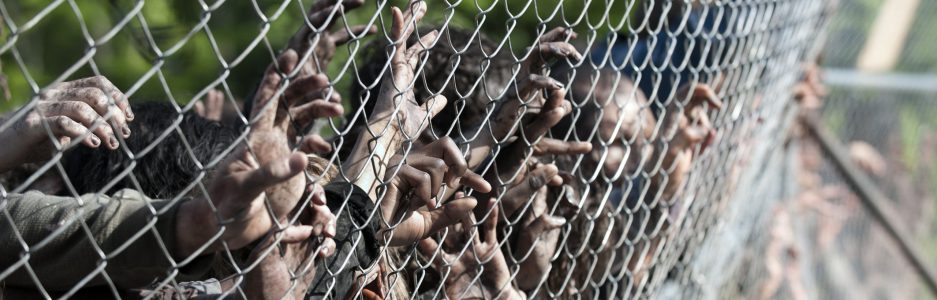
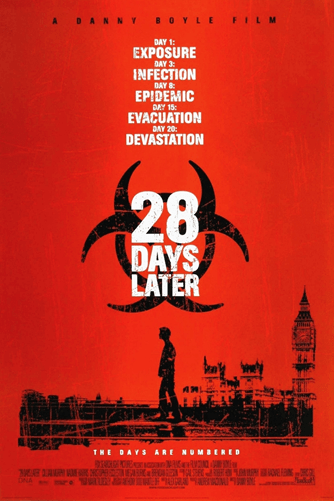
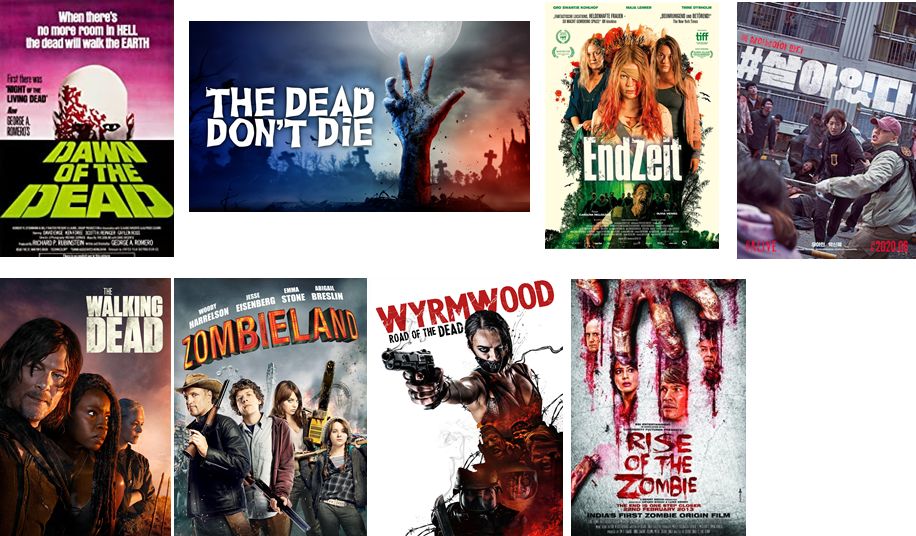

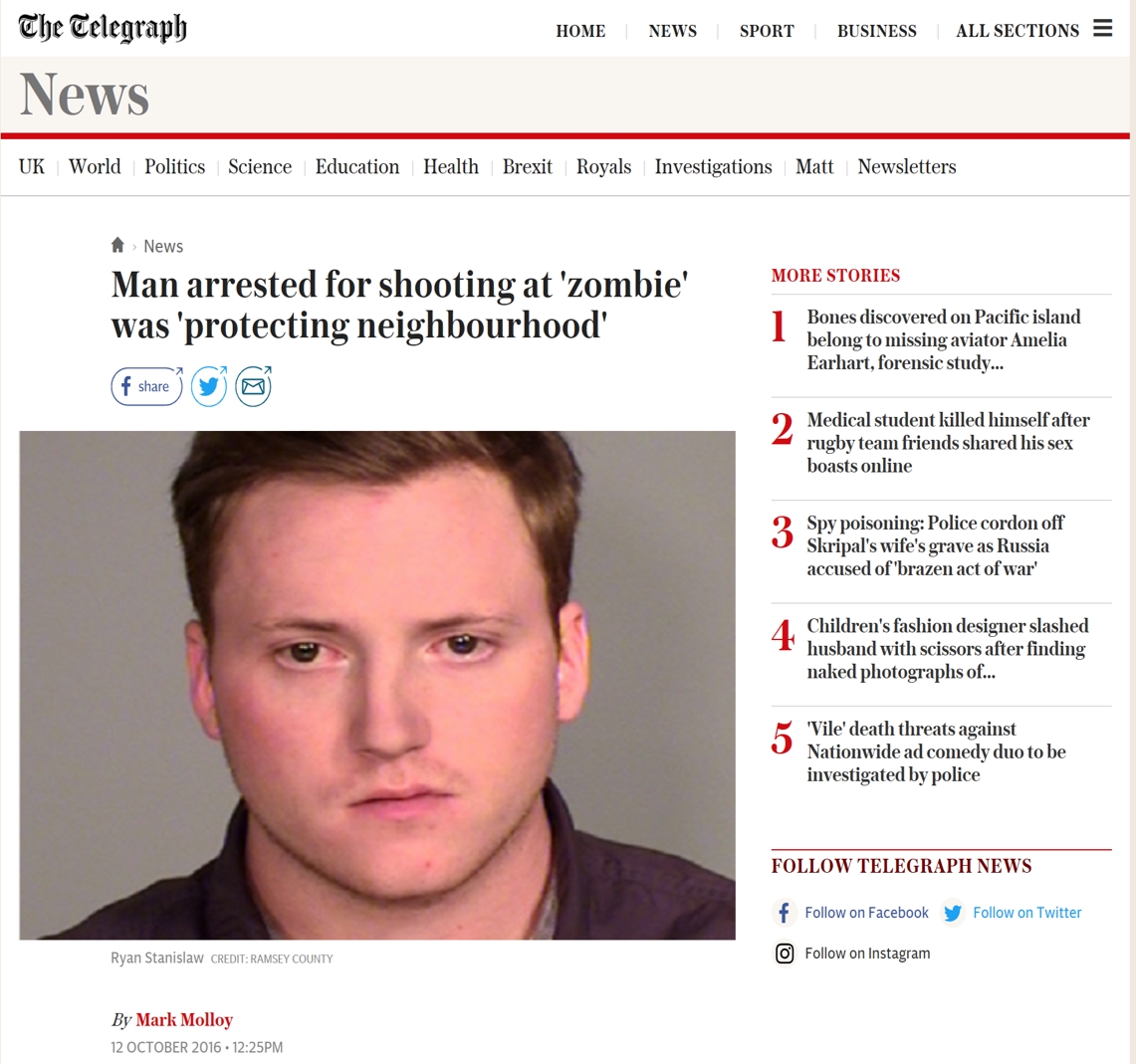

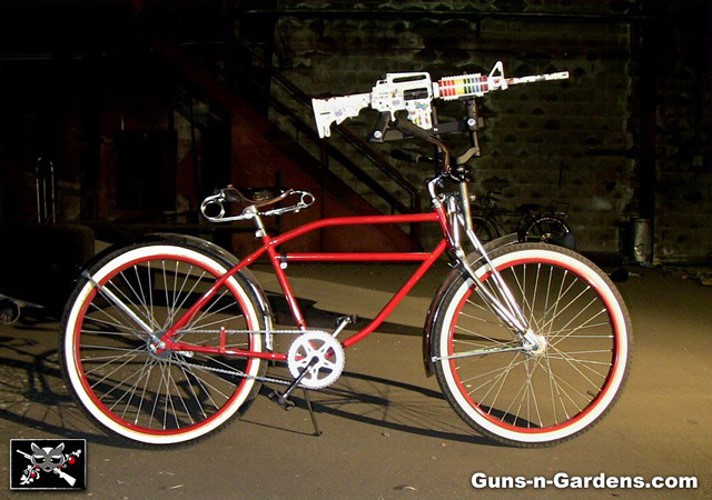
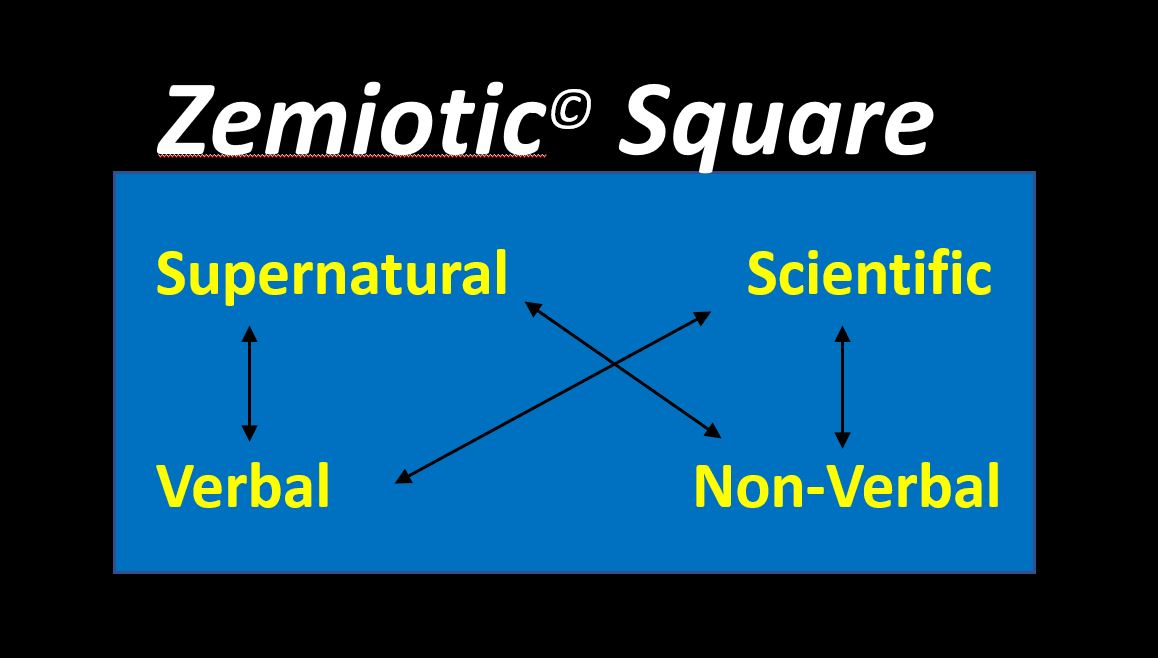
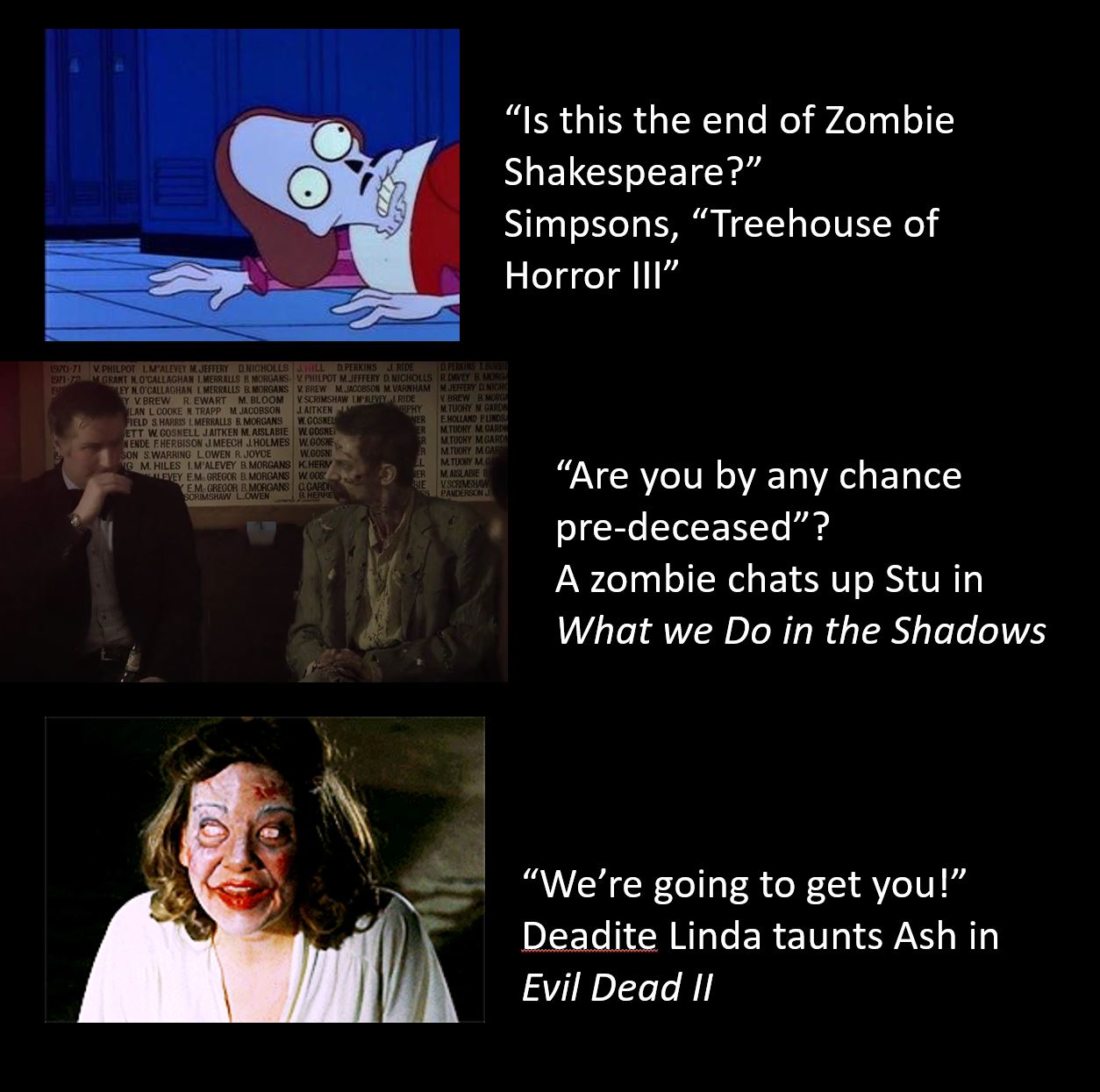
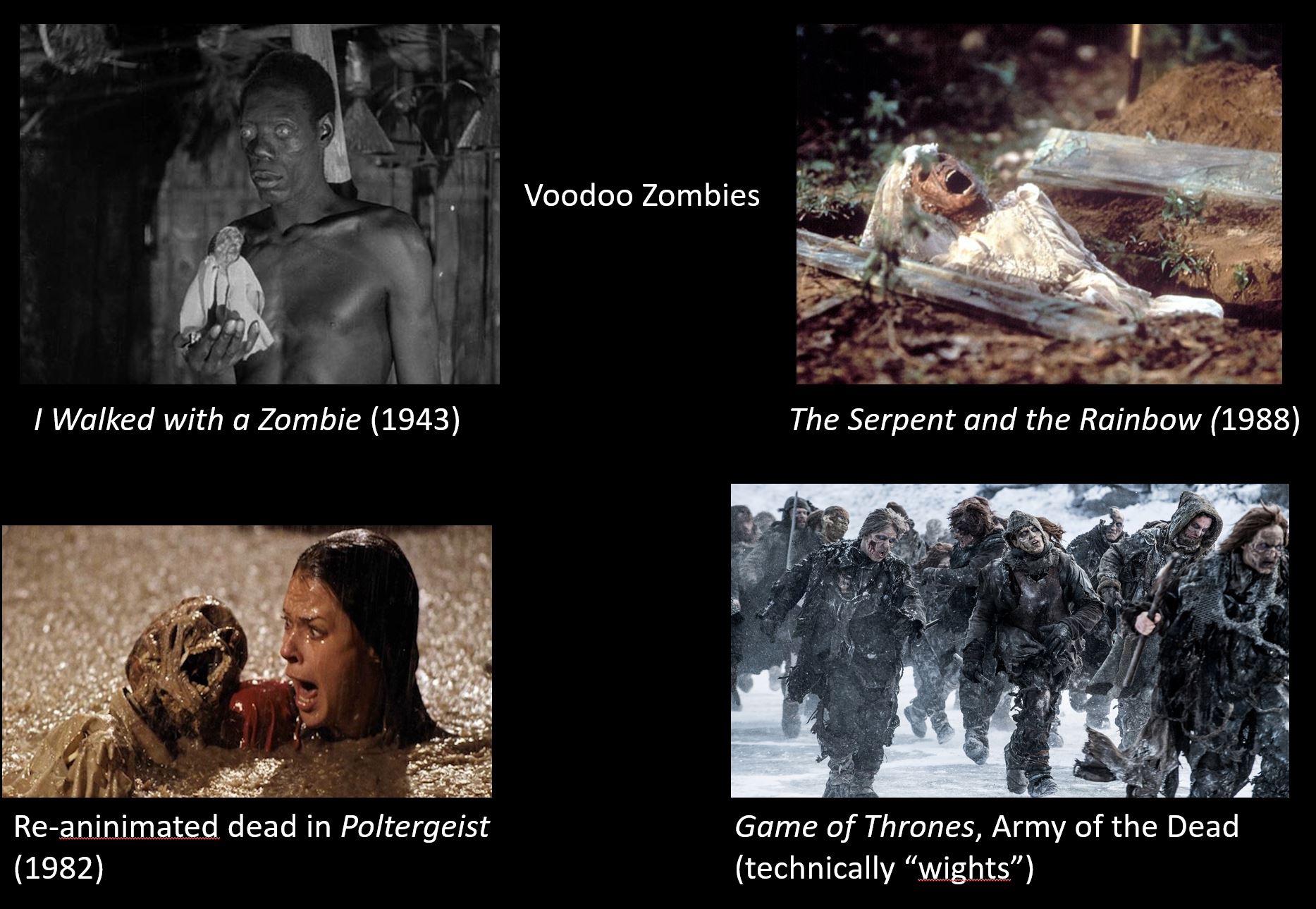
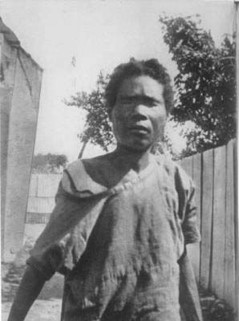
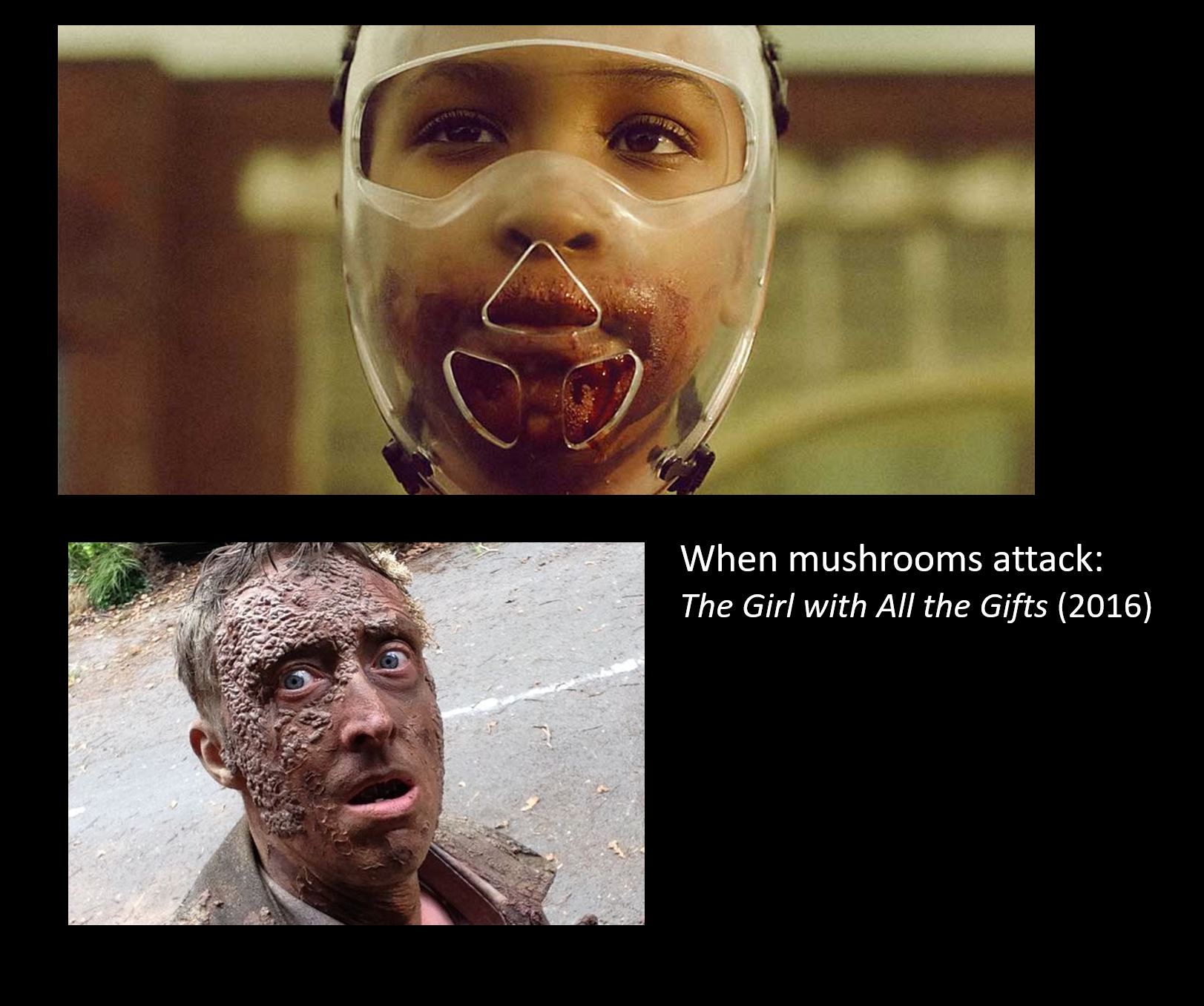

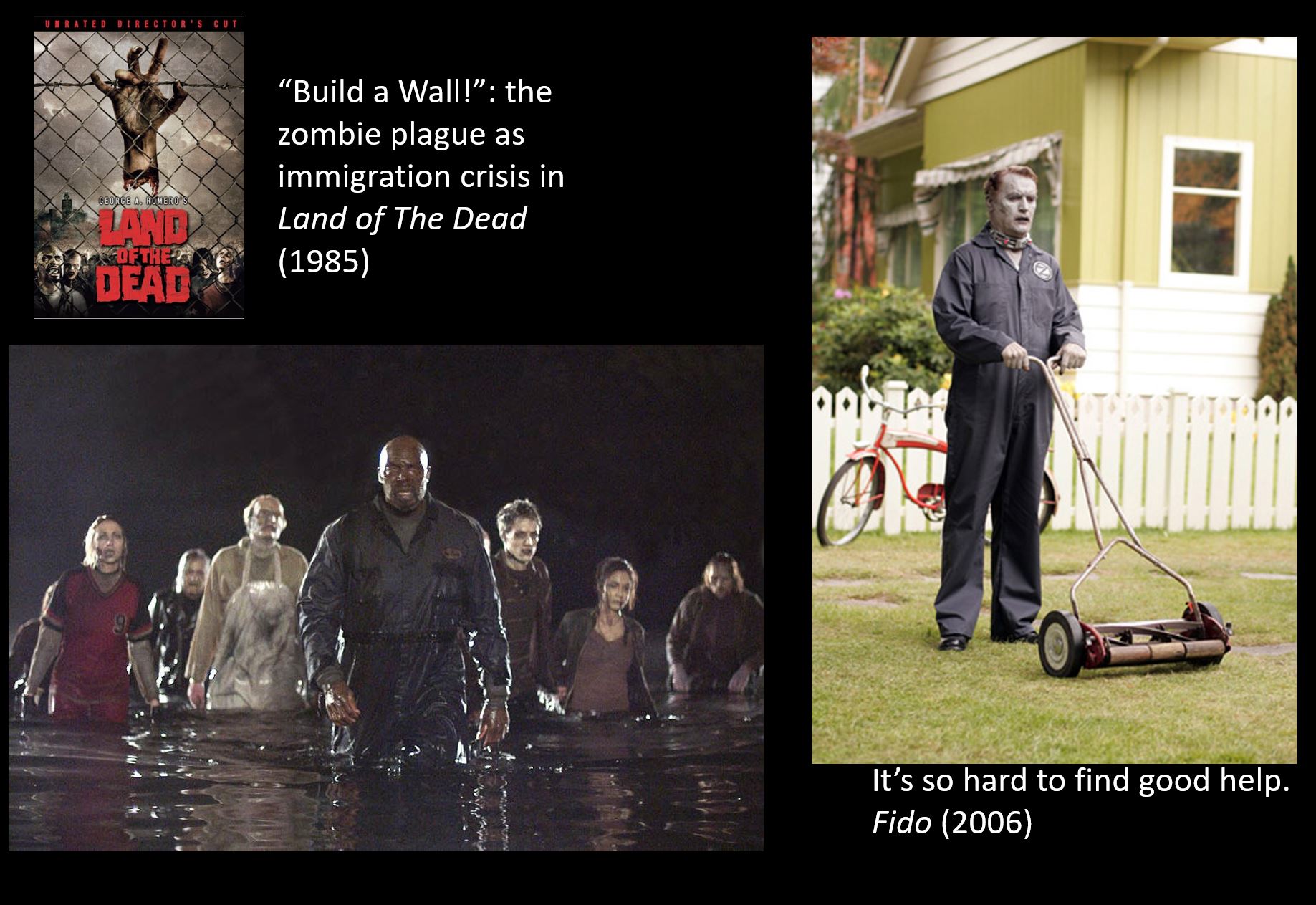
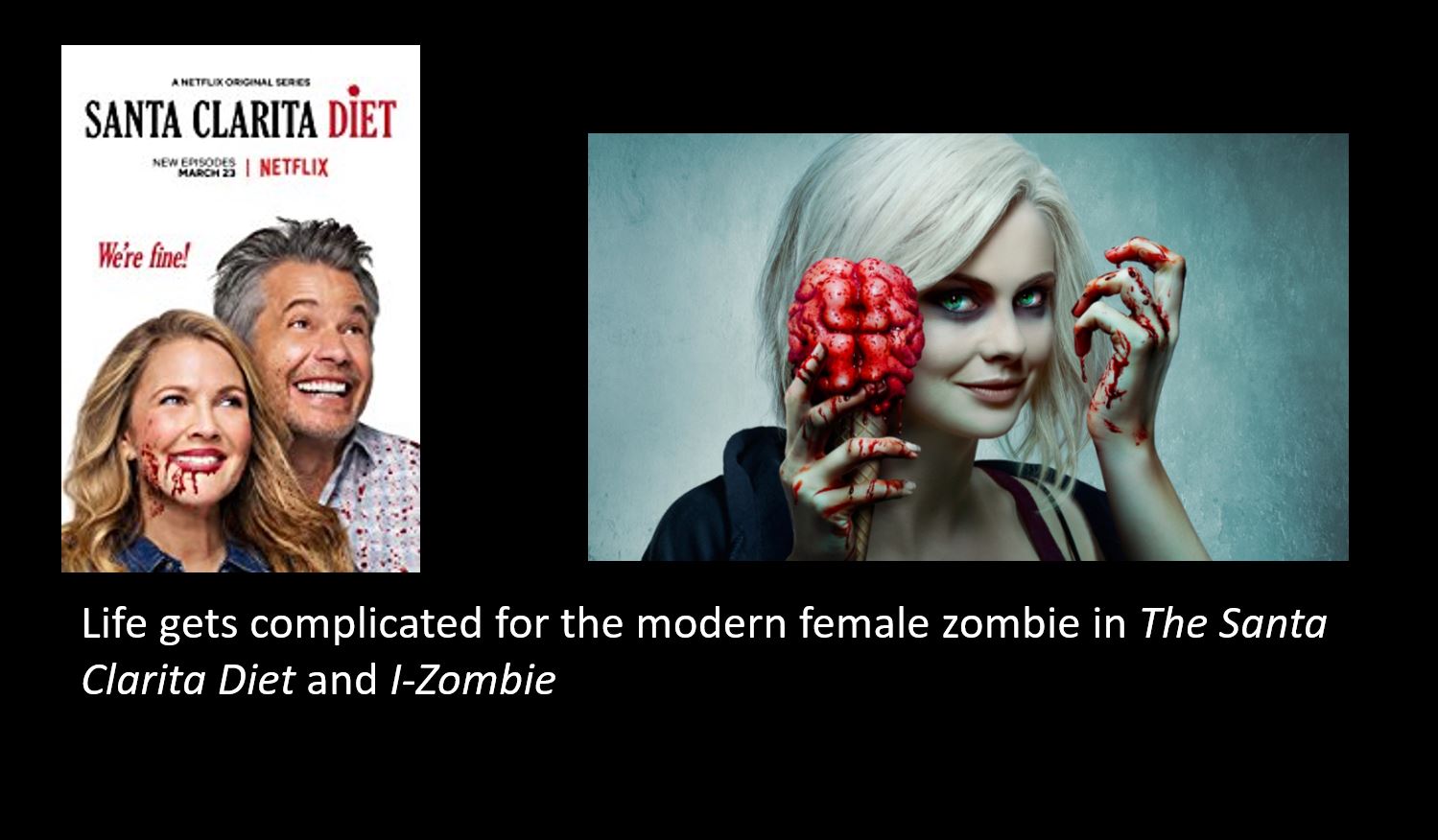
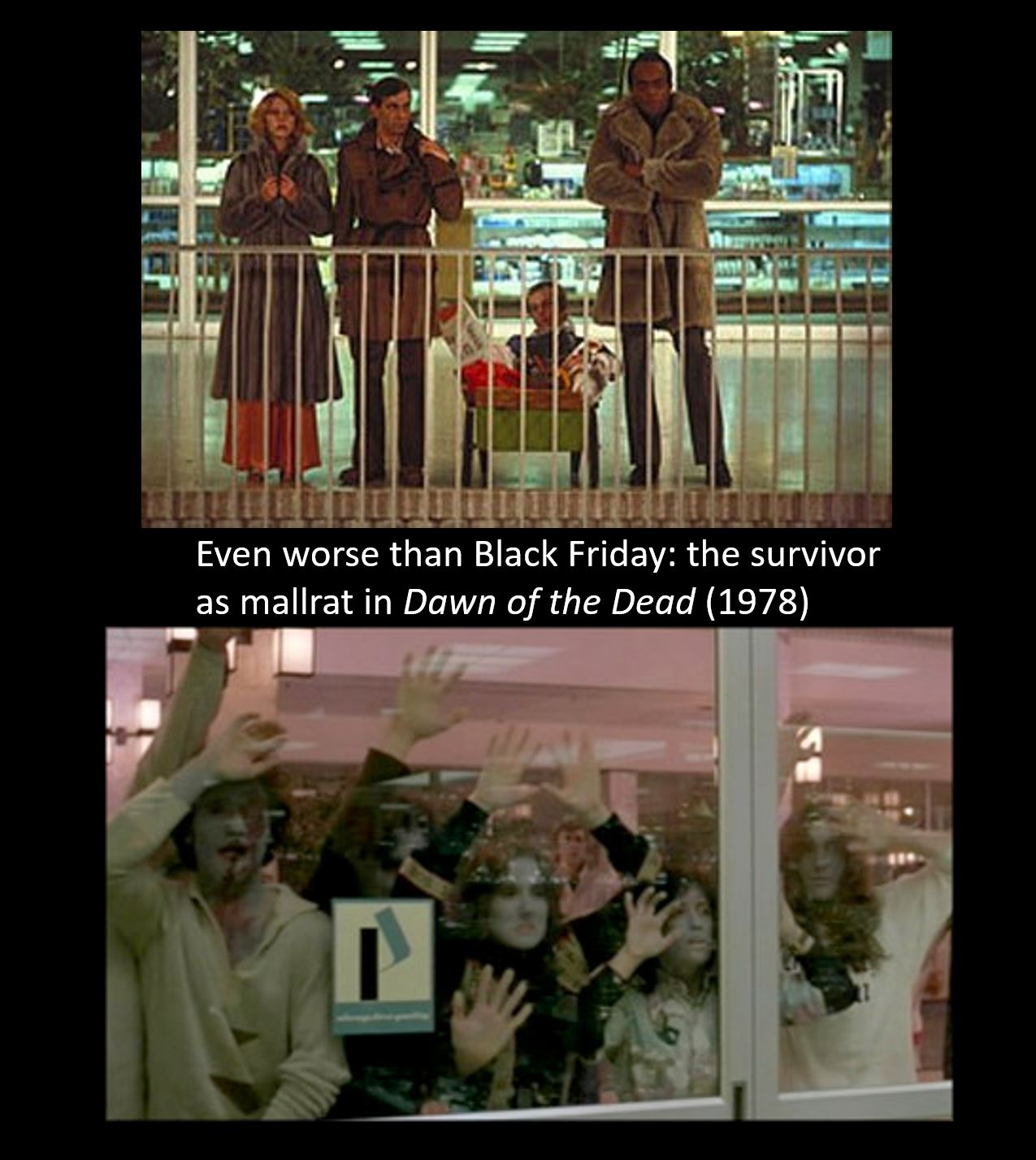
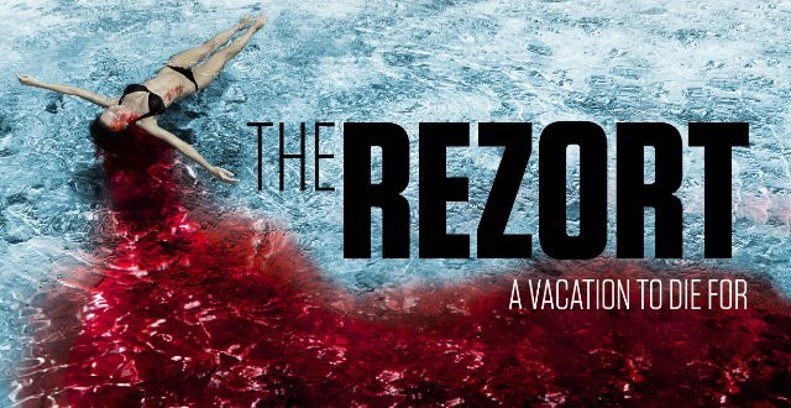
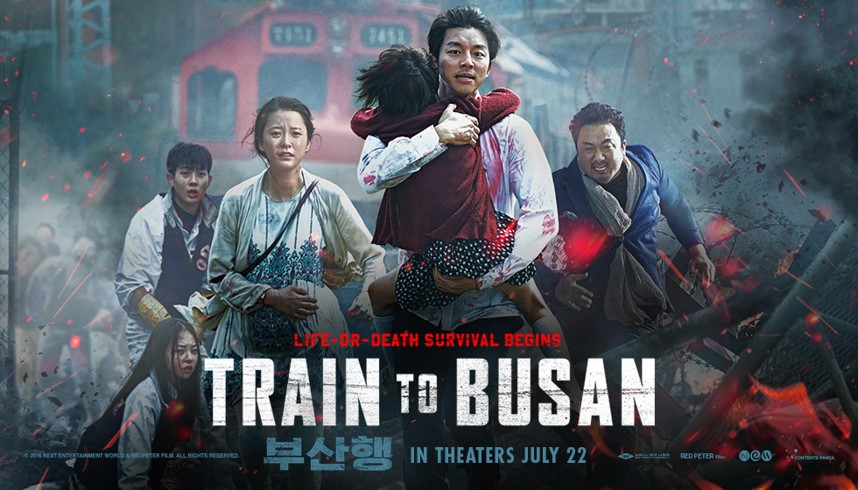

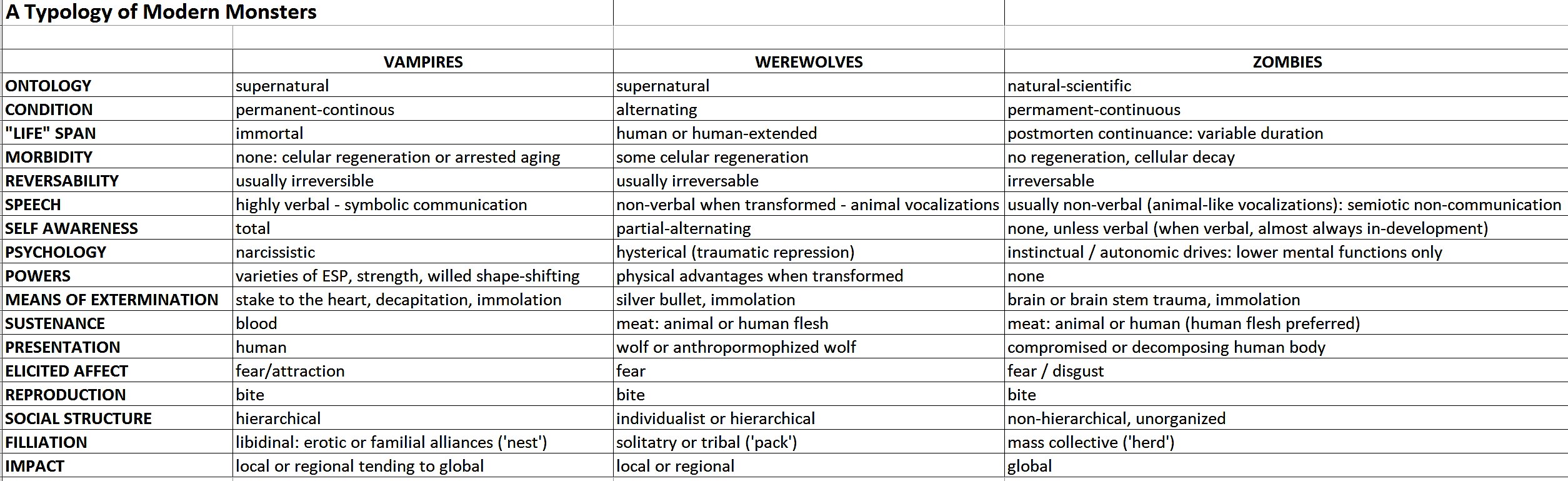
 Thoughts on Zombies